WEST OLIVE — Ottawa County will formally join the state's review of the $330 million Silver Maple Solar project after the Board of Commissioners voted 10-1 on Tuesday, Oct. 27, to petition the Michigan Public Service Commission (MPSC) for intervenor status.
Commissioner Doug Zylstra cast the only "no" vote. The board then approved two follow-up motions: one directing County Administrator Patrick Waterman to coordinate the county's position and hire specialized legal counsel, and another letting the county use the $50,000 that developer RWE Americas sent it to cover the cost.
The votes came during the board's regular 9 a.m. meeting at the county's Fillmore Street campus in West Olive. Discussion of the three items ran about 50 minutes.
Commissioner Jordan Jorritsma moved to authorize the administrator to file a petition to intervene "by the November 12, 2026, deadline." Commissioner Joe Moss, whose District 5 includes the project area, seconded the motion.
Voting yes were commissioners Jacob Bonnema, Jorritsma, John Teeples, Allison Miedema, Kendra Wenzel, Jim Barry, Sylvia Rhodea, Moss, Vice Chair Phil Kuyers and Chair Josh Brugger.
Jorritsma said the project is "going to affect our community. It's going to affect our roadways, our waterways." Several commissioners described intervening as getting "a seat at the table." Barry also pointed to drainage and water concerns raised by Water Resources Commissioner Joe Bush.
Teeples aimed his criticism at the state law that moved siting decisions for large renewable projects to the MPSC. "I think that Public Act 233 is shameful for the state of Michigan," he said. "Three people are going to dictate what happens in Ottawa County." He added, "You can blame the developer. You can blame the farm owners. My blame is right in Lansing for this."
Bonnema said "some bureaucrats in Lansing sat in a cubicle and wrote this up." He described the Smallegan family's legal fight with RWE as "a separate issue" from the question in front of the board.
Zylstra said he sees the matter simply as individual landowners and farmers exercising their private property rights. He warned that intervening could set a precedent for the board stepping into other communities' decisions. "I think that restraint — there's also virtue," he said, adding he would vote not to intervene.
Brugger said he is "probably the only commissioner up here who actually owns part of a solar panel," through the Grand Haven Board of Light and Power's community solar program. "I am very much supportive of solar and I don't see us as intervening as being opposed to solar," he said. He compared the vote to the board's unanimous request earlier for a public voice on proposed deep-well injection. "What exactly we say, that's where we may disagree," he said. "But I really feel like we all ought to agree on giving Ottawa County … a voice."
The agenda had listed a Nov. 23 deadline. The motion as read and approved used Nov. 12, which matches the date county attorneys gave at the Oct. 16 work session.
Rhodea moved the second item, with support from Jorritsma. Rhodea then offered an amendment that the board approved on a roll call. It changes the administrator's role from developing the county's position to coordinating its development. It also says the county's substantive policy position "shall remain subject to the direction and approval of the board of commissioners."
The amendment also requires express board approval before the county is bound by any host community agreement or related settlement. That includes any commitment to support the project, withdraw from the case, waive appeal rights or otherwise limit the county's legal rights. Corporation Counsel Doug Van Essen said he had no problem with the change.
The amended motion passed with Zylstra voting no.
Before the vote, Barry said the amended process for setting the county's position still wasn't spelled out well enough: "I just don't think it's concrete enough." He pressed the deadline: "We're either at the table or we are permanently not at the table."
Waterman said no lawyer had been chosen yet. The county is aware of at least three attorneys with experience before the MPSC and also wants someone skilled in cross-examination. Any contract would come back to the board for ratification.
The county's regular outside counsel, Ron Bultje, is stepping aside from the case because his law firm has a contract with RWE. Commissioners were told the firm set up an internal screen. Bultje said he had represented Zeeland Township for decades, stepped aside when the case began and later resigned from the township entirely.
Van Essen laid out the timeline:
Van Essen said he attended the Lenawee County case, where the same judge accepted that county as an intervenor. He said the record built before the judge "is arguably the most important part" of the process.
County officials said they would start on strategy as soon as counsel is retained and would likely schedule a special meeting to discuss it. "I for one am glad we didn't move into this intervention earlier," Teeples said.
Before the vote, a commissioner urged Zylstra to join the majority. "Are you telling me how to vote?" Zylstra asked. A commissioner replied that the board would "love for you to join us." Zylstra still voted no.
The agenda called for a voice vote on the funding. Commissioners asked for a roll call instead, and the motion, made by Moss and seconded by Kuyers, passed.
The money comes from a provision of PA 233 that requires developers to fund local governments taking part in state siting reviews. The cap is $75,000 per affected local unit and $150,000 per project. RWE sent $50,000 checks to the county, Zeeland Township and Jamestown Township.
Van Essen compared it to a divorce case in which one spouse pays the other's legal fees: "It doesn't mean that you're buying off your spouse." He said a grid analysis would be the most expensive piece. Farmland questions could be handled in-house by the county's strategic impact staff. Commissioners noted that if costs run past $50,000, the administration must come back to the board for more.
"I don't think in any way it sways us to be in RWE's favor," Teeples said. "We have been put in a position by a corporation to need to go to bat on this issue." He said he didn't blame RWE or the Smallegans: "We have a law that we have to live with now. So let's stay within our lane to see if we can play a positive role in that development."
Most speakers at the opening public comment urged the board to intervene. Among those who spoke:
At the closing public comment, one resident said she heard more debate during public comment than among commissioners. She said commissioners voted to intervene before saying what the county's position should be, and she criticized commissioners who "call out a commissioner who did not vote with the majority."
In his report later in the meeting, Waterman said the board should consider a policy on when the county will intervene in future large energy cases. Rhodea had suggested intervening "in every case" at the Oct. 16 work session.
Silver Maple PV LLC, the project company for RWE Americas, is seeking a state siting certificate for a 200-megawatt solar facility in Jamestown and Zeeland townships, about 4.3 miles east of Zeeland. The project area covers about 1,914 acres. About 1,431 acres would be disturbed and 1,127 acres fenced, according to the MPSC's notice of hearing in Case No. U-22071.
RWE says the project would power about 34,000 homes and generate more than $30 million in property taxes over its life, including more than $15 million for education, according to its project website. RWE first applied in April. It suspended that application after the Michigan Court of Appeals ruled that the county counts as an "affected local unit," then refiled Sept. 18.
MPSC staff have until Nov. 17 to decide whether the application is complete. If it's approved, RWE plans to begin construction in late 2027 and have the project running in the second quarter of 2029.
The application falls under PA 233, which took effect Nov. 29, 2024. The law lets developers of large wind, solar and storage projects seek approval from the MPSC instead of local zoning boards. Zeeland Township has sued, claiming the law is unconstitutional.
Moss has already opposed the project in a comment to the MPSC, which he shared in an April 7 Facebook post. "Approving this project will negatively impact prime farmland, local residents, Ottawa County, and the State of Michigan," Moss wrote.
A host community agreement is a deal negotiated between a project developer, such as RWE Americas, the company proposing Silver Maple Solar, and the local government hosting or affected by the development.
In exchange for certain commitments by the developer, the local government may agree to terms addressing the project's development, operation or community impacts.
A host community agreement for a large solar project might include:
That last category is especially important. Some host community agreements are structured to secure a local government's support or cooperation in exchange for negotiated benefits, though not every agreement includes such a provision.
Section 227 of Michigan's Public Act 233 of 2023 requires a developer seeking a state siting certificate to enter into a host community agreement with each affected local government.
The agreement must require a payment of $2,000 per megawatt of nameplate capacity located within each affected local government's jurisdiction, due when operations begin. The money can be used for police, fire, public safety or other infrastructure, or for other projects the local government and developer agree on.
If a local government refuses an agreement after good-faith negotiations, the developer can instead enter into a community benefits agreement with qualifying community organizations that serve its residents.
Tuesday's vote came two weeks after Ottawa County Circuit Judge Jon Hulsing ruled Oct. 14 that RWE properly exercised lease options on about 562.8 acres owned by the Smallegan family. That land is roughly 30% of the project area. The order bars the family from taking part as an intervenor or party in any proceeding in which they oppose the project.
The family was also ordered to pay RWE's legal fees and has until Oct. 29 to appeal. The Hollander covered the ruling here.
The county must file its petition by Nov. 12, ahead of the Nov. 19 prehearing conference. The board has a special meeting Nov. 5, which Waterman said is for a closed session on collective bargaining. Its next regular meeting is at 6:30 p.m. Nov. 17.
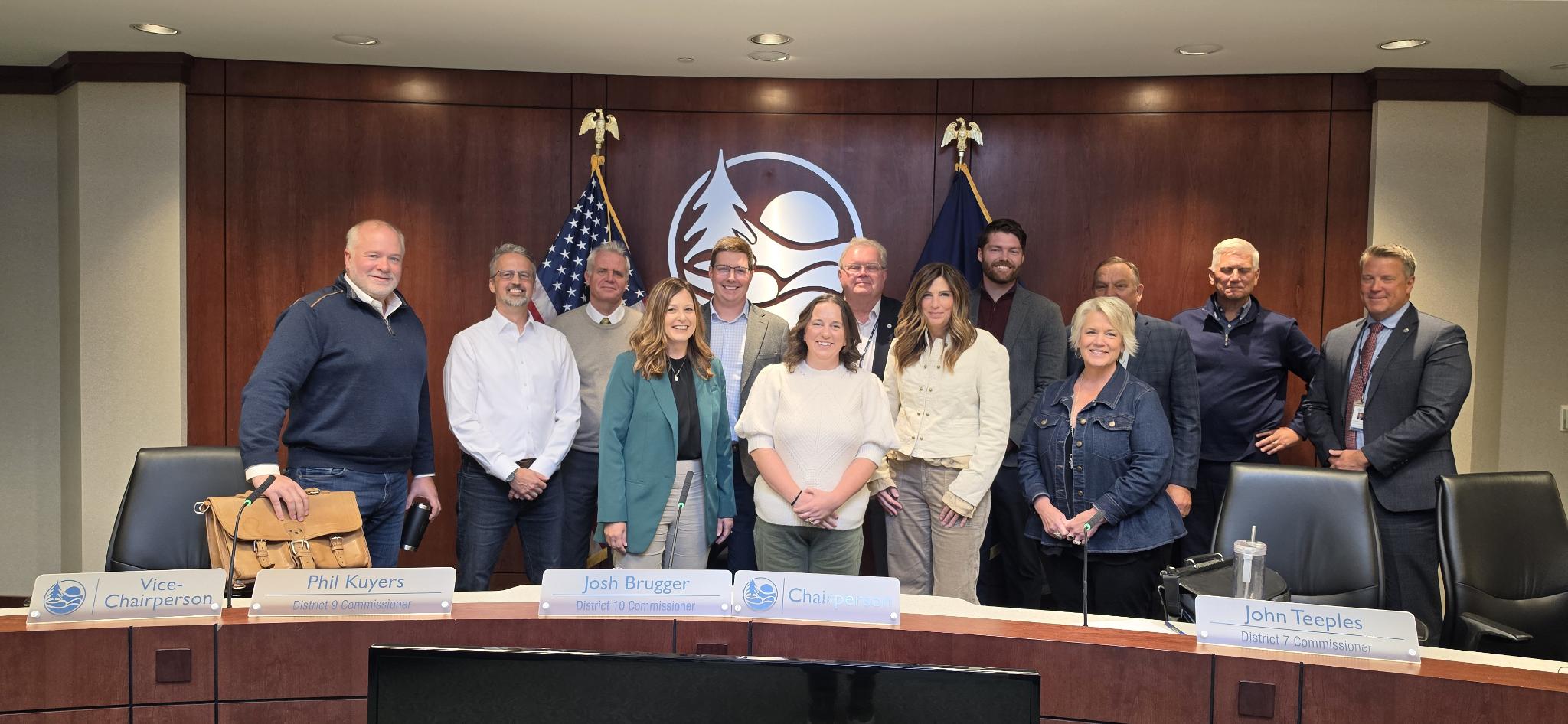
Photo courtesy of Ottawa County.

Copyright © 2025 Hollander Media. All Rights Reserved. This material may not be published, broadcast, rewritten, or redistributed without written authorization. By providing your email or phone number, you are consenting to receive emails, calls, and SMS/MMS messages from The Hollander and affiliates. Msg & data rates may apply.