In 1926, our nation was in the midst of a cultural boom, from cars and consumerism to cultivated entertainment. There were conversations about prohibition, the ebb and flow of the economy, and the next best product as seen through glamorous advertisements.
During this time, Holland, Michigan was a premier beach destination. It was accessible via the interurban, it housed a clean beach that drew in tourists, and it offered a quick-growing, quaint downtown scene.
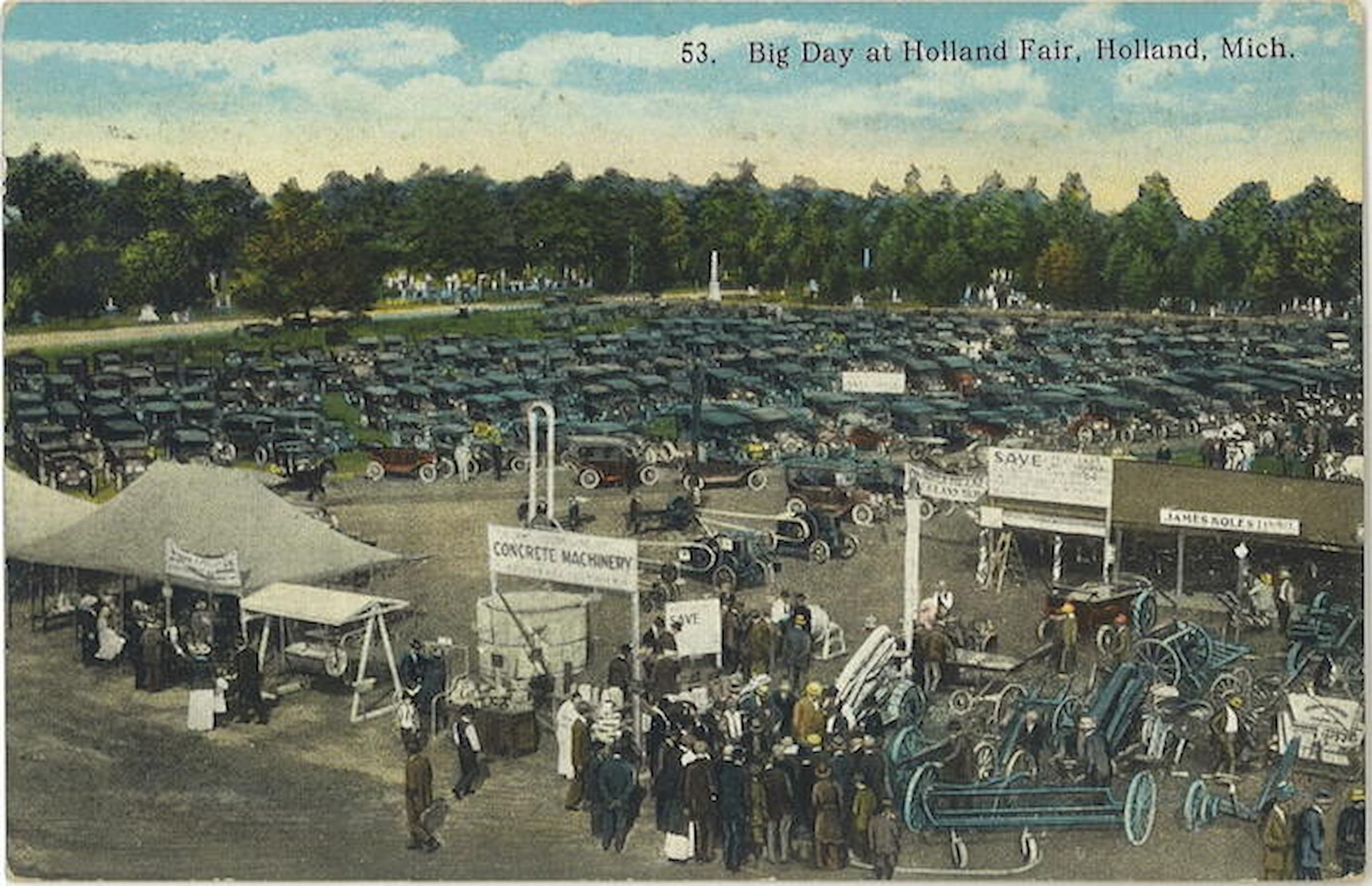
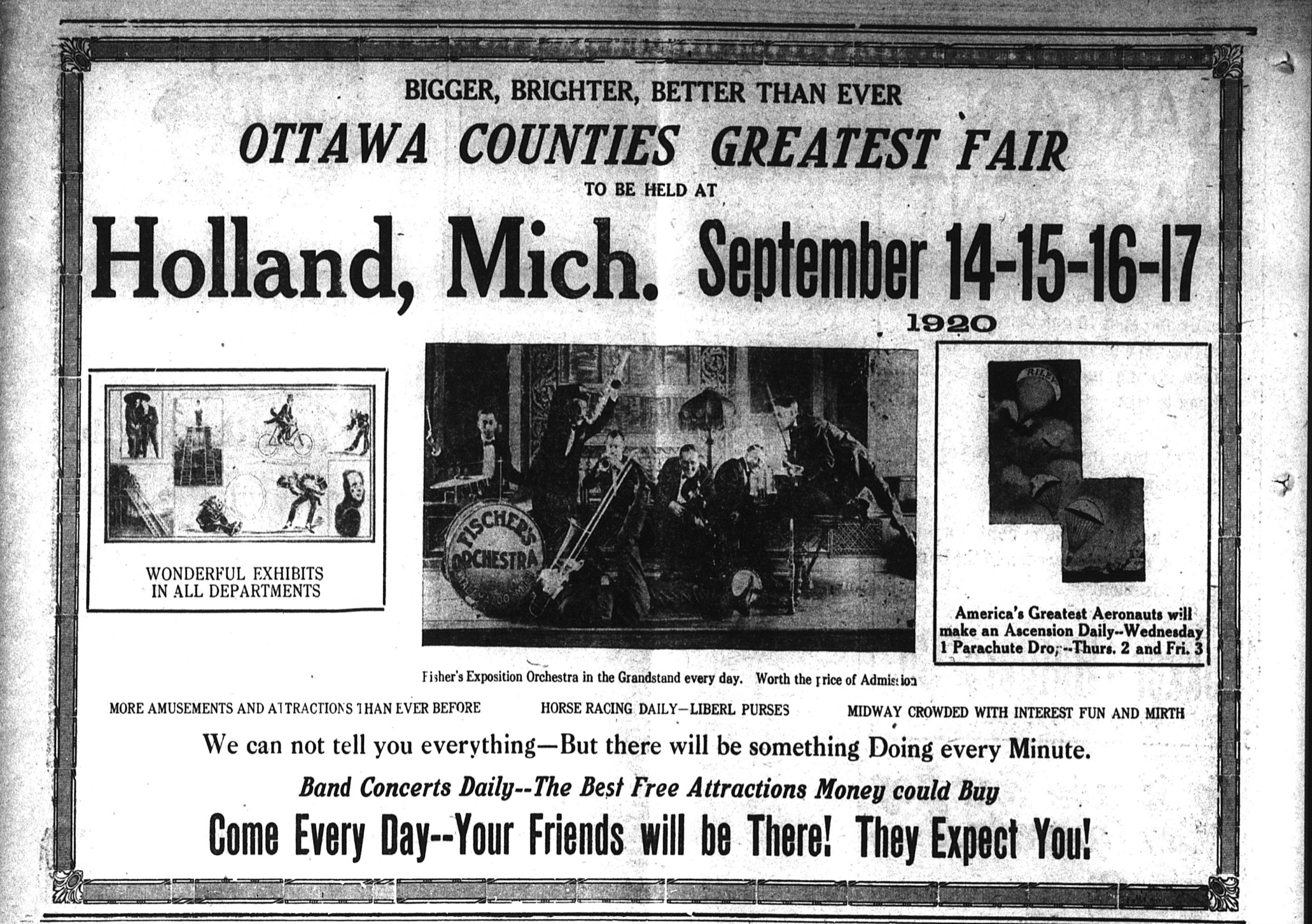
It was also home to the Holland Community Fair—a spectacle scene with prize-winning horses, hundreds of dogs, children’s calf competitions, flower exhibits, fruit displays, new automobiles, and merchants showing off their latest products.
It wasn’t your average fair experience, either. It was much more than that. It was a mere few days where locals could step out of their day-to-day life, able to see what was known as “the spectacular.”
Before the fair, Market Day on 8th Street was considered the spectacle of the time. It allowed local merchants to come together to trade while the wives shopped. It featured numerous posts for agriculturalists and farmers alike to showcase and barter off their goods. It became inherently violent over time as frequent fights, foul language, and rowdy crowds forced it to dismantle.
The Holland Community Fair was its replacement. It began sometime in the mid 1880s.
It was an extension of the original market days—as Robert P. Swierenga describes it to be a “combination of education and entertainment; education was the purpose and entertainment the lure.”
It promoted innovation in animal husbandry, agricultural machinery, and the best farming practices. It allowed for proper gentleman farmers to showcase their recent findings in new crops, animal care, and helpful machines without the risk of brawls or other hoopla.
And aside from the practical components of the fair, it was the perfect showcase for “all things spectacular”—from horse races to acrobats to flower exhibits.
In August 1926, the fair celebrated its 42nd anniversary. The opening day experienced a record-breaking crowd. The treasurer receipts for the initial session were the largest the fair had seen in years.
For three days, more than 20,000 people came to see it all.
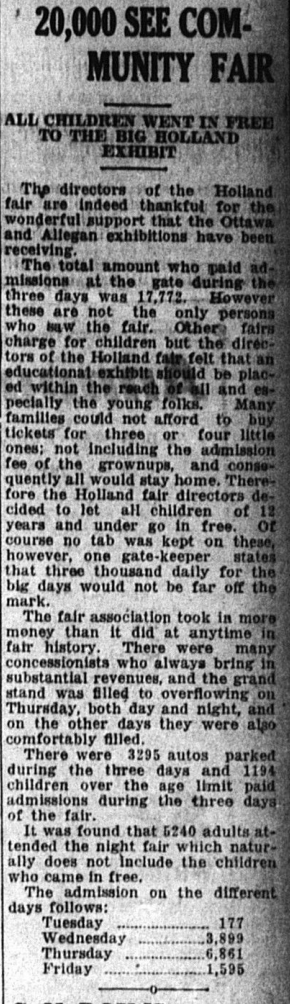
In the September 2, 1926, edition of The Holland City News, reporters estimated that 17,722 paid admission tickets were sold over the course of three days. But that wasn’t the full attendance because children under the age of eleven were admitted free. In the same report, it was said that one particular gatekeeper estimated nearly 3,000 children attended per day. This paper therefore puts the total attendance at more than 20,000 people.
What was even more telling is the fact that 3,295 automobiles were parked during the three days at the fair. The grandstands overflowed on Thursday, both day and night. And the fair association reportedly took in more money than any previous fair in its history.
In other words, Holland had plans.
And apparently, so did everyone else.
The fair wasn’t just a local affair.
To put it into perspective, per the census numbers reported between 1920 and 1930, the population of Holland, Michigan was somewhere within the range of 13,000 to 13,500.
So of course, if we do the math, then where did the other roughly 7,000 attendees come from?
The fair attracted visitors from numerous surrounding communities, from Grand Haven and Saugatuck to Grand Rapids and even Detroit. Some big names were in attendance too—from Michigan Circuit Court Judge Orlen S. Cross to Grand Haven County Clerk William Wilds to the prominent Grand Haven figure and his family, Frank Bottje.
Aside from the exhibits of enhanced agricultural tech and animals, which were the fair’s educational side, the entertainment was its unapologetic attempt to keep people staring.
And there was plenty to stare at.
The “Elephant” Crowd-Pleaser
“Oh, please. There is no such thing as elephants in Holland, Michigan,” is what you might have heard people say if they hadn’t yet read the previous week’s newspaper. If they had read it, they would have learned that a “troop” of elephants had made their way into town.
Mr. and Mrs. Race and Jeanette C. Power owned and toured their four elephants across the globe. These elephants weighed a combined 15 tons. And naturally… this was a problem. The platform in front of the grandstand, where they were meant to stand during the showcase, wasn’t sturdy enough to hold them.
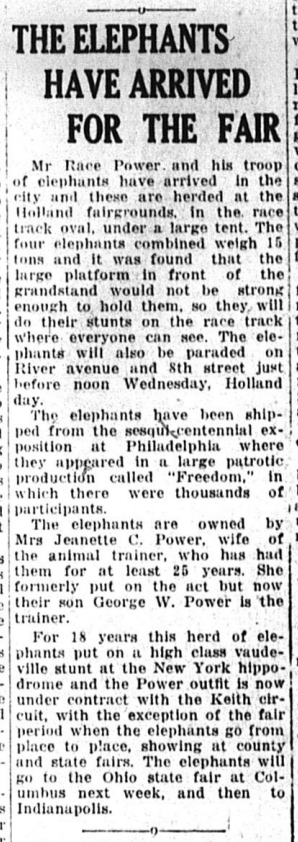
So of course, the elephants went onto the racetrack.
Their vaudeville tricks were performed directly on the track oval, giving spectators front row—or perhaps, front-row-and-a-half—view of the enormous performers.
And, get this. Not only did the elephants perform at the fair, but they were also paraded through River Avenue and 8th Street, which added a little extra pachyderm-powered excitement to the city. So… next time you walk downtown, perhaps you remember that elephants once walked the same street.
Thrill-Seekers in the Skies
If the elephants weren’t enough to keep spectators looking up, the fair had another trick.
The Vandenberg Bros. Oil Company sponsored twin sisters who performed hot air balloon ascensions right in front of the grandstand. These performances featured single and double parachute drops, because apparently the perfectly ordinary descent from a floating balloon was not dramatic enough.
They also tossed coupons down to the crowd for free five gallons of gasoline.
Fireworks with a Bit of Razzle Dazzle… and an Ode to the Revolutionary War?
The fair saved another spectacle for the evening, in particular.
Claude B. Casler of the Thearle-Duffield Fireworks Company had arranged for a massive-themed firework show in the track oval to honor the nation’s 150th anniversary.
The theme? 1776.
The show featured fourteen sets, including “1776 vs. 1926,” which was written in letters of fire. There were also depictions of George Washington, Paul Revere, and President Calvin Coolidge, turning the night sky into a grand celebration of the nation’s founding.
Bring Out the Horses
The horse show itself was a captivating feature of the fair.
About four years before it was added, the idea was no more than a small exhibition in Waukazoo, where wealthy visitors had participated. By 1926, it had grown to acquire more than 50 entries.
Most prominent horse owners were from Grand Rapids, Detroit, and Holland and wanted to bring their “blooded stock” to showcase at the fair. John Wood Blodgett and Warren H. Snow of Grand Rapids both entered their thoroughbred and English-bred riding horses into the show.
These horses were judged through a variety of events that involved walking, running, hurdle jumping, and other riding demonstrations. Seth Nibbelink, who had been a speed secretary for over 25 years, returned from Florida to help run the races alongside his son, James. The fair introduced three classes of running horse races brought in from the Ionia Fair.
And, the show wasn’t just about the stunning horses themselves. It was about the performance.
Mrs. Charles Kirchen had received a round of applause as she cantered past the grandstand on her horse. The crowd was captivated. The riders knew it. And… the horses might have started to catch on that they’d become celebrities.
The Show-Stopping Dog Show
Then there were the dogs.
We don’t typically see ourselves taking the family pet to showcase at the fair anymore. But they did it back then. The press called the number of dogs entered in the fair’s bench show as “one of the big surprises at the fair.”
There were at least 150 entries which filled the poultry building that had been set aside solely for the dog show. Amongst the breeds at this year’s particular show were Alaskan Malamutes, Airedales, Collies, and “Chinook of the North.”
And on the exact day of the attraction, a mother dog had given birth to eight puppies when the fairgrounds opened.
Even Flowers Were in Competition
If you had a beautiful spring bloom, perhaps you took it to the flower exhibit at the summer fair.
The flower exhibit had become so popular that officials were already planning to construct a building to host it for next year’s fair. The news reported a record number of entries and an “exceptionally fine collection.”
Shady Lawn Florists took home 59 first prizes, while Ebelink Company received 24 honors. It seemed that flowers could be serious business.
Let’s Judge the Fruit
Even your homegrown fruit creations had a spot at the fair. A basket of fruit or jar of jelly, which normally would sit unnoticed at home, suddenly had an audience—and a chance at a ribbon. This event was called “the finest seen in years,” with fruits, jellies, and other entries that would be judged by the local women.
Step Right Up
The local merchants put up the most extensive exhibit—hundreds of decorated booths that offered anything from automobiles, furniture, and insurance to children’s toys. There were dozens upon dozens of booths. There were Dodge and Chevrolet cars showcased. There were the newest inventions displayed. It was the talk of the town.
Niagara Falls (But Make it Holland Style)
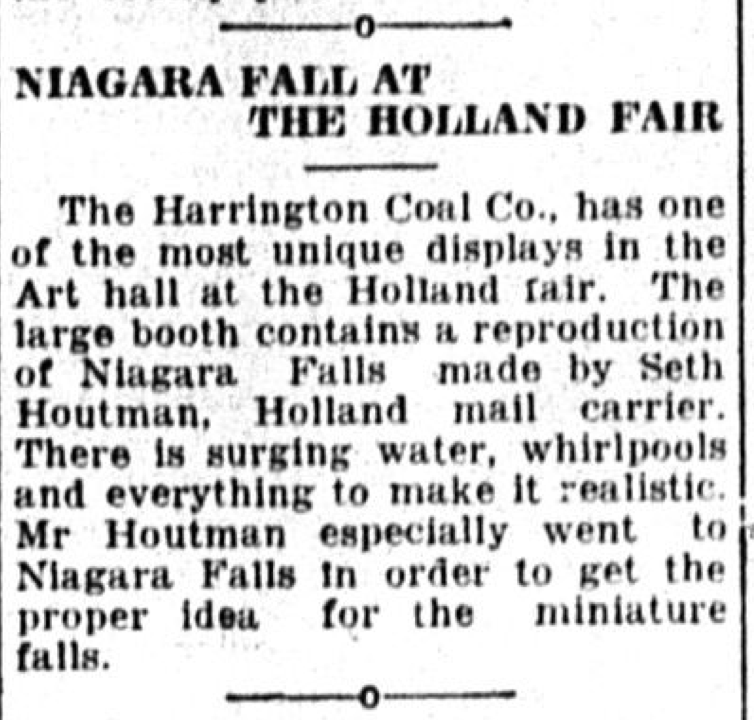
Wait… we don’t have waterfalls here. But in 1926, we did. Harrington Coal Co. showcased a booth with a realistic miniature replica of Niagara Falls, complete with surging water and whirlpools. It was built by a local mail carrier, Seth Houtman.
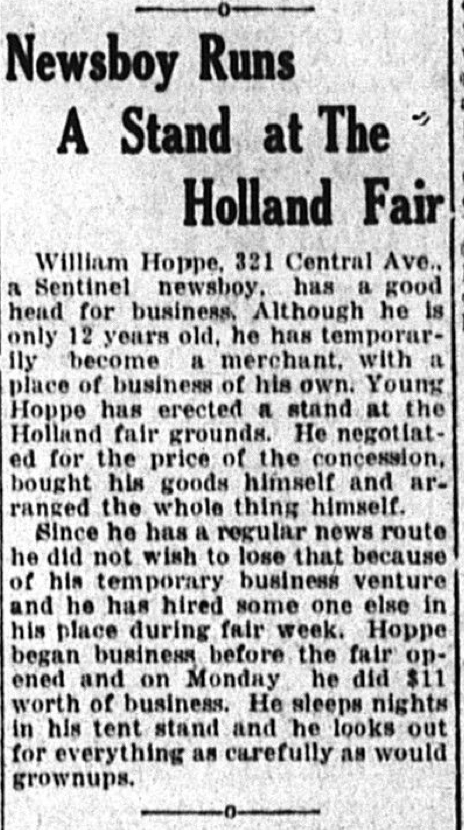
The 12-Year-Old Entrepreneur
A local newspaper boy, William Hoppe, rented and ran his own merchant business at the fair. He bought and supplied his own products. He was a Holland Sentinel newsboy, and, to run his fair business, he needed someone to cover his position. So, he hired a temporary replacement.
Hoppe collected exactly $11 worth of business. (That’s roughly $210 if converted to buying power in 2026). Not too shabby for a young merchant.
The fair even had its own “censors”—a two-man board, established by the fair, who ensured that only “clean shows” were present on the fairgrounds. This was a new addition to the 1926 fair, as previous years had experienced complaints about inappropriate shows. T
The paper says that the previous year there had been objections—particularly from Zeeland—about some of the attractions at the Holland Fair.
So in 1926, the directors decided that only “clean shows” would be allowed.
Once the concessions opened, the two men went around inspecting them.
And they actually shut things down.
The first was a “girl show” that the censors considered inappropriate. The newspaper says it had “too much Hawaiian.”
Another concession was running a “skin” game, which was also shut down.
The secretary explained that concessions could look perfectly acceptable on paper but become something different once business began. The fair intended to remove the bad attractions and allow the good ones to remain.
The 1926 Holland Community Fair chose its dates to match the Allegan Fair. And apparently this was done after Allegan had announced its dates. The Allegan Board of Management was reportedly “very bitter” about it. The announcers at various events reportedly emphasized that the “Allegan Fair is successful in spite of Holland.”
For three days in August 1926, Holland had plenty to look at.
From elephants to horse races to balloon acrobats, thousands of visitors filled the fairgrounds to see what their neighbors—and the wider world—had to offer. It gave everyday things a stage. A horse became a champion. A flower became a prize winner. A washing machine was an attraction.
Then, just as swiftly as the fair began… it came to an end. But there was always next year. And the next… and the next.
For More Information

Sierra Ozolins is a West Michigan native, currently a student at Hope College. As an athlete, she is passionate about fitness—from running to weightlifting. With a interest for politics and lifestyle, she is intrigued how local culture, community, and everyday events shape the world around her—often with an iced coffee in hand and her dog by her side.
Copyright © 2025 Hollander Media. All Rights Reserved. This material may not be published, broadcast, rewritten, or redistributed without written authorization. By providing your email or phone number, you are consenting to receive emails, calls, and SMS/MMS messages from The Hollander and affiliates. Msg & data rates may apply.