Key Capture Energy (KCE) wants to put a battery energy storage system (BESS) on approximately 12 acres of farmland in Blendon Township. However, elements of the proposal did not meet zoning requirements.
At the Planning Commission meeting in February—by a slim 3–2 margin—it was voted to grant exemptions to the Township’s zoning ordinances, allowing the application process to continue. According to Township Attorney Ron Redick, Michigan Public Act 233 permits the Planning Commission to grant variances normally restricted to the Zoning Board of Appeals.
At the beginning of the Planning Commission’s Special Meeting on Wednesday, March 4, the floor was given to Township Planner Andrew Moore to summarize KCE’s 1300-page application, including its numerous appendixes, as well as reports from Township staff.
It took well over an hour for Moore to give his review. Groundwater was one of the topics of most concern. Moore explained that a geological engineer from the Township had reviewed the plans and agreed with the assessment—there's not a hazardous liquid stored in the containers or on the property, so the overall risk of the project is “generally pretty low.”
Even so, the engineer noted that the water table of the property, like much of the township, is close to the surface and the soil is sandy, making for a “vulnerable aquifer.” If something does get into the ground, it wouldn’t take long for it to drain through the soil and into the groundwater supply. But again, the risk is low.
Another topic covered in more detail than previously was the habitat assessment. It was found that six federally listed protected species have the potential to occur in the vicinity of the project area. But as long as conservation measures are observed during migratory seasons, no further coordination will be needed.
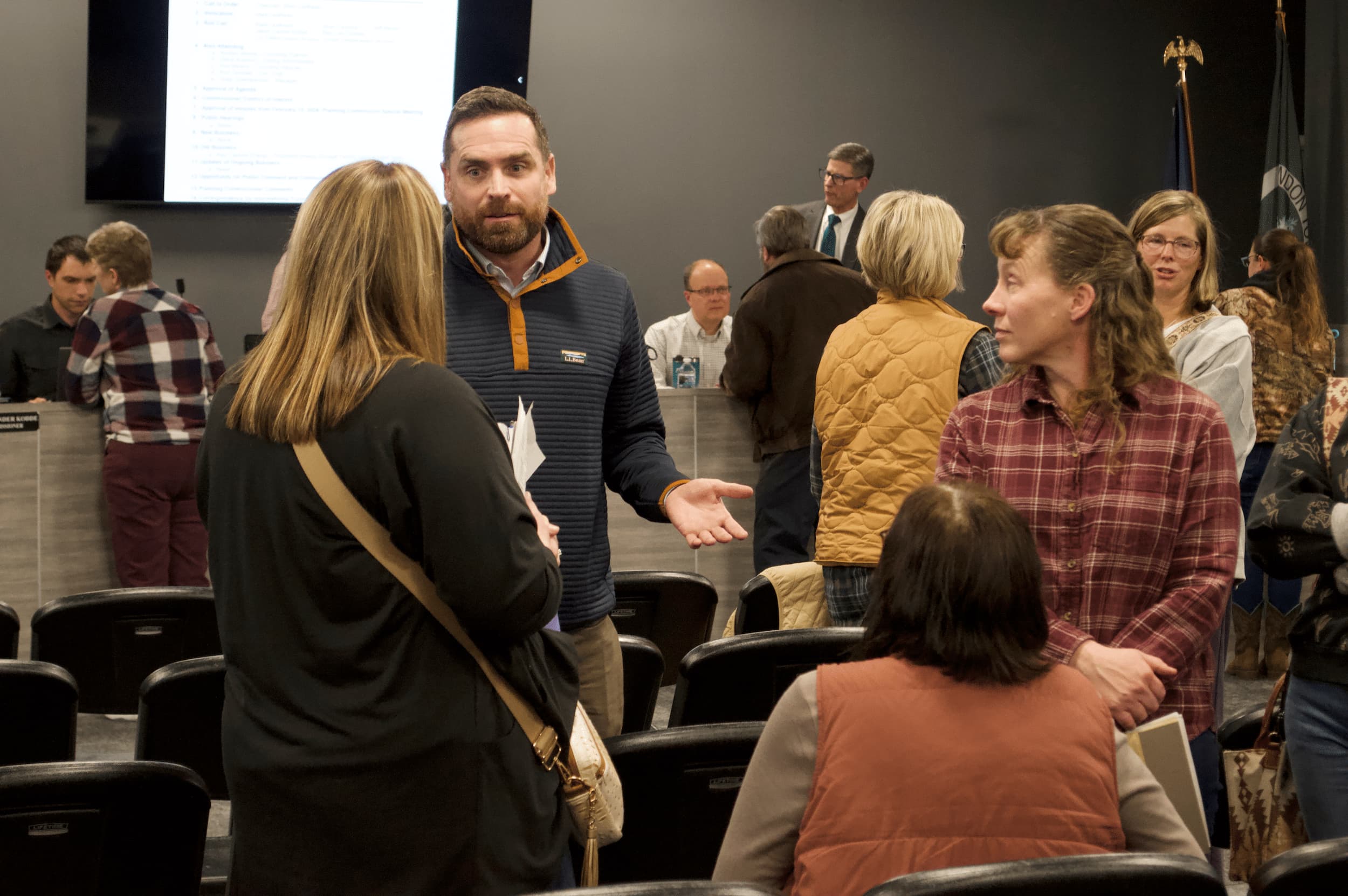
At the conclusion of Moore’s painstaking summary, commissioners asked questions of KCE.
Both Commissioners Jason Vander Kodde and Ben Van Zweden made comments on the appearance of the application. Vander Kodde pointed to where images were cut off or missing and Van Zweden to his frustration over the usability and the duplicate pages in such a “massive document.”
Van Zweden went on to question the property values report, saying he would like to see a study on property values that are adjacent to a facility that has experienced a thermal runaway.
Chair Mark Leathead asked if KCE had decided on the type of battery that would be used. Brian Madigan, KCE’s Lead Project Developer, responded that right now they’re giving their best guess. If the project is approved and gets a permit, a final decision will be dependent on the technology available at that time. He added that it’s too early to commit to which will be used. Members of the crowd let it be known they did not approve of this answer.
Madigan later explained that the chemistry of the battery would be the same, lithium-iron phosphate. It is the manufacturer that might change.
Leathead asked why KCE only had submitted a 30% site plan, saying that the Commission typically receives a full site plan. Madigan said that the 30% refers to the level of detail that's appropriate for a discretionary decision, which currently is before the board. Further detail would be provided later in the process.
Redick interjected that the site plan will be a condition of approval that will be brought into the resolution, if the application continues, and the Special Land Use won't be effective until KCE complies with all the requirements. The project will not go forward without that approval.

The next part of Moore’s report addressed some of the public comments that had been made over the last several meetings. Moore focused on eight areas of concern.
1. Fire/thermal runaway: Moore explained that while the number of BESS-related accidents has stayed the same, the proportion has changed. There are increasingly more BESS facilities and not increasingly more accidents. He added that a BESS has individual containers, and even if there were a thermal runaway, the effect is limited to one individual container. Additionally, there is nothing in the submitted plan that suggests an evacuation radius or that people will get evacuated from their homes, though that could happen if there were a significant event.
2. Blendon’s Rural Character and Master Plan: Moore said he does think more could be done in the plan in terms of landscaping, particularly on the south side which could be visible when there aren’t leaves on the trees.
3. Groundwater: There is a containment basin proposed for the main transporter to prevent water runoff.
4. MPSC and PA233: If the Township were to deny the application, KCE would go to the MPSC. Van Zweden questioned the explanation given that the denial of the application would result in the Township forfeiting $75,000 toward an MPSC hearing. Redick said he would get clarification on that point.
5. Decommissioning: The estimated cost for decommissioning is about $964,000. Moore said a one-time bond of a million dollars isn’t satisfactory because that amount won’t spend the same in 20 to 30 years. That issue is still being discussed.
6. Property maintenance: The maintenance plan continues to be developed.
7. Conflict of Interest: Regarding Commissioner Jordan Dekker being the property owner leasing to KCE, Moore said that conflict of interest happens. Sometimes a commissioner works in construction or owns the piece of land in question. When the issue first came up, Mr. Dekker informed the Commission, the conflict was discussed, and it was agreed he should recuse himself from the conversations.
8. Precedents: When it comes to Special Land Use and zoning decisions, every application is different. The property, the neighbors, the natural features, land impacts, and traffic patterns are all different. Every application is evaluated on its own merits. If the Planning Commission approves or denies this application, it does not bind the Commission to doing the same going forward unless somehow there is an exact same situation. It’s important to have some consistency in the process and the principles you apply, but the Commission isn't bound to the same conclusion for every application.
Moore summed up his presentation with his and the Township staff’s opinion—which hadn’t changed. He said that given the circumstances and the significant effect of PA233, “we maintain the opinion that the best approach long term, that best protects the township would be a very conditioned, eventual approval of the project.”
Lest the crowd think Moore was announcing the inevitable, the Chair spoke of the upcoming meetings which would include various experts in the field. The County Drain Commissioner will be coming in April, and Consultant Michael Bryon will follow. There also will be a meeting focused on decommissioning. Leathead assured the room there will be a few more meetings to gather facts and start compiling conditions, calling the plan a “deliberative process.”
.jpg)
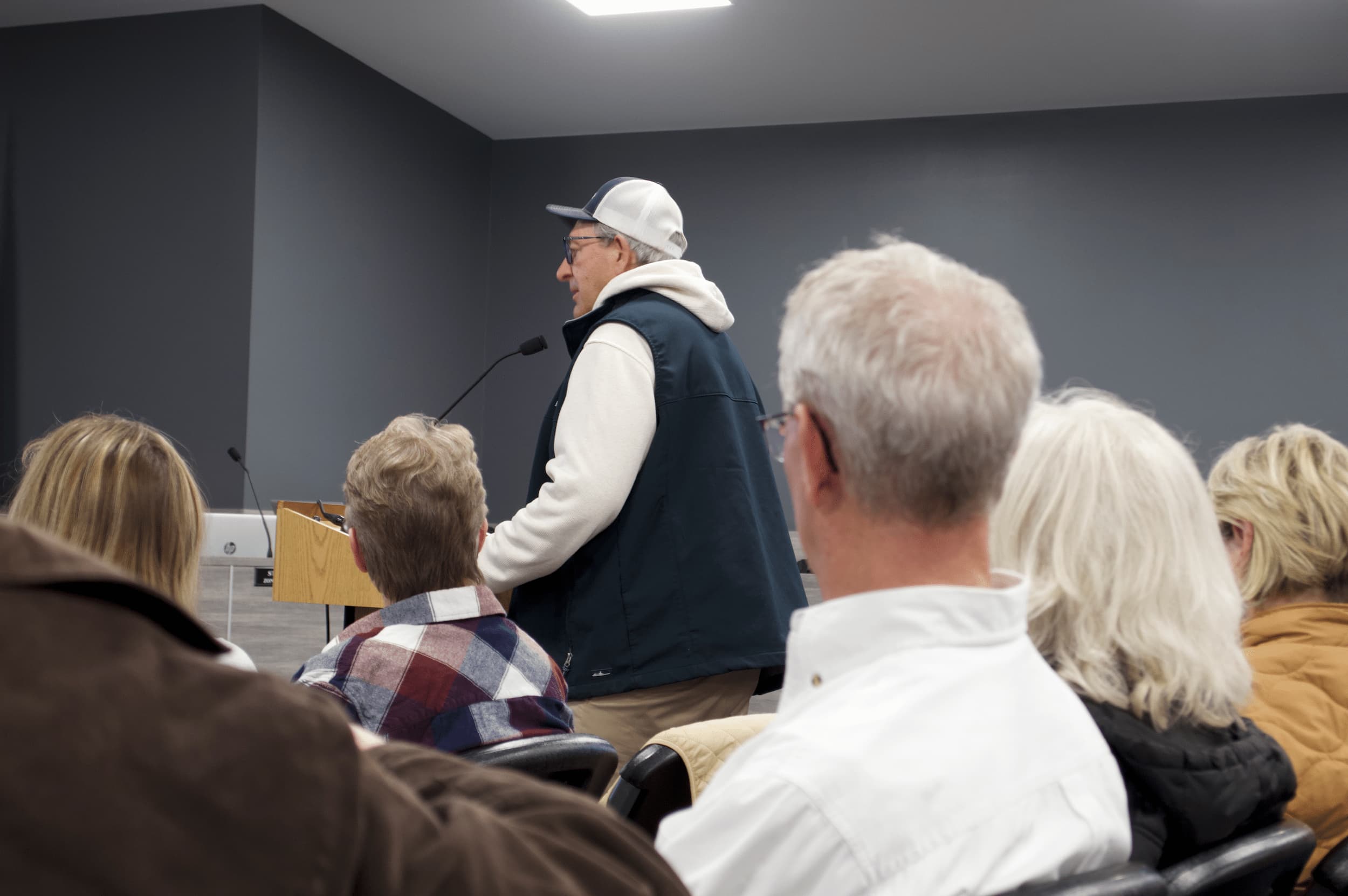
Residents from the community took their turns at the mic. It was pointed out that with the stepping down of Commissioner Lyn Peters and the reclusion of Dekker, the board is incomplete, and that when a vote happens it would be best to have a full board to maintain the integrity of the Planning Commission.
One common thread in the comments was about how contaminated water travels. KCE, founded in 2016, has no long-term data available for groundwater. The concern was that once the groundwater is contaminated it will go into the aquifers, all the way to the Great Lakes.
Residents wanted to know why developers are after their farmland.
A question was asked about the jobs coming from the project and whether they would be mostly for contracted workers. A KCE representative responded that because these projects are so expensive to build, only a contractor of a certain size and qualifications would have the bonding capacity to meet the payment and performance obligations of the mortgage provider. There are about 10 large regional electrical contractor firms, typically based out of Detroit, that will submit a bid—one then acting as the prime contractor. The contracting would be up to them.
There were two political candidates who addressed the board. Michael Markey, who is running for State Senate, talked about how developers come to townships first because they think it will be faster. They instead should be going to Detroit where they've leveled tens of thousands of 100-year-old houses that had lead pipes, lead paints, and asbestos. The ground is garbage. He said that if developers are going to encapsulate something in concrete, that would be the place to do it.
Markey encouraged the Commission to get past November when the Republicans will take back the Senate and governorship and restore local control. Then the Planning Commission will be in charge and able to represent what the community truly wants.
Roger Victory introduced himself as a State Senator and a secondhand farmer. who understands the water level issues. He cautioned that once you contaminate that reservoir, you don't get it back. You don't get a second chance. You don't get a third chance. “So, I ask of you,” he said, “get it right. I don't care how long it takes.”
As the meeting came to a close, the statement that hung in the air was one pondered by a resident during her public comment:
“I can't but help but wonder which headlines we will eventually see:
‘Small Michigan Communities Stand up to Large BESS Developers’ or ‘Another Small Michigan Community Betrayed by Talented Leaders Who Ignored Public Outcry.’
"I know I'm not alone in praying that you will do the right thing," she concluded. "Please help us.”

Krista Yetzke is a native of Ottawa County. A jeep-driving, guitar-playing wife, mom, and everyday adventurer, Krista was raised on the love of Jesus, the great outdoors, the arts, the value of frugality, and the beauty of food as medicine.

Copyright © 2025 Hollander Media. All Rights Reserved. This material may not be published, broadcast, rewritten, or redistributed without written authorization. By providing your email or phone number, you are consenting to receive emails, calls, and SMS/MMS messages from The Hollander and affiliates. Msg & data rates may apply.