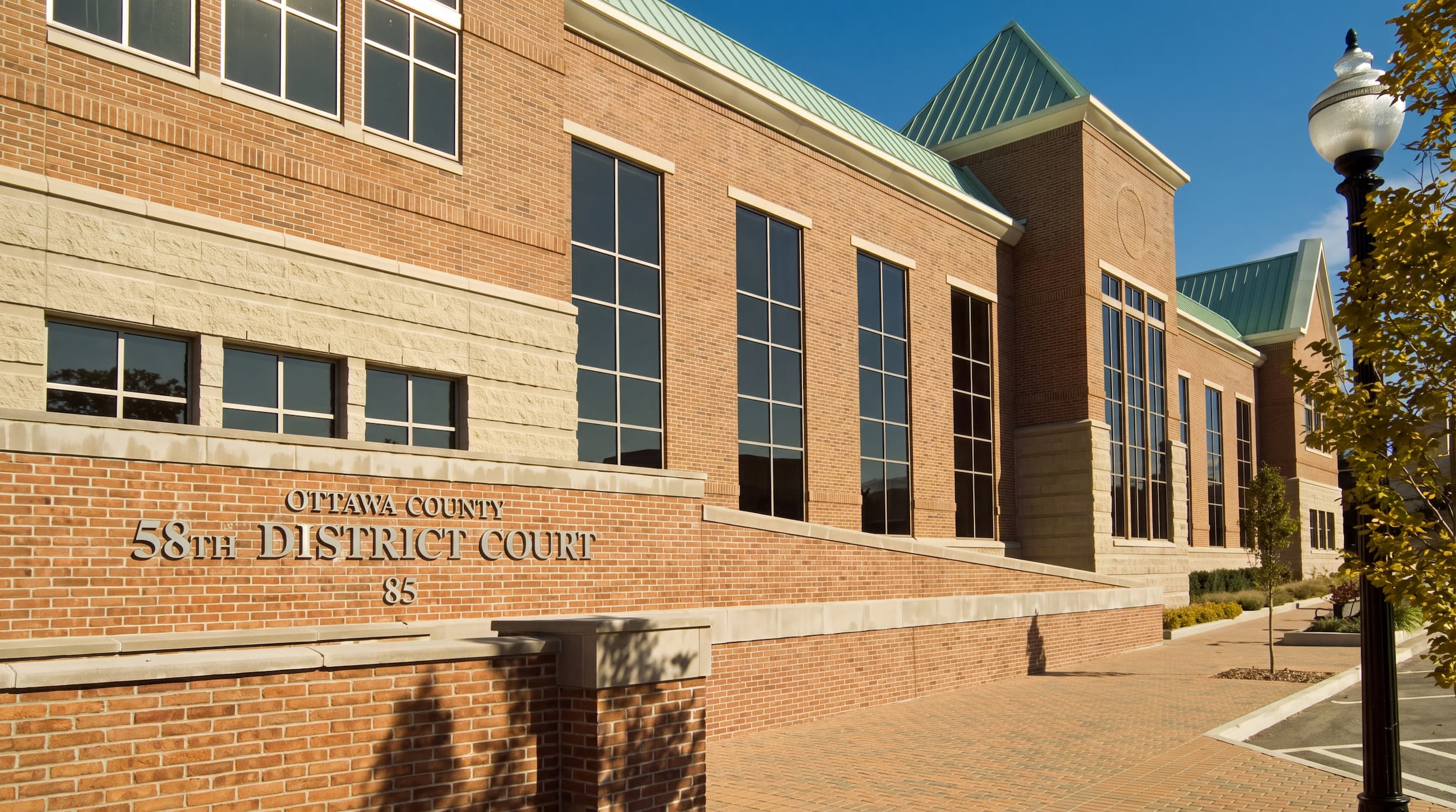
Back in 2024, there was a swirl of media narratives implying county commissioners were giving themselves a 60% pay increase. In reality, the Officers Compensation Commission (OCC)—a volunteer board that meets during even numbered years—is responsible to review elected official salaries and present recommendations to the Board of Commissioners (BOC) to approve or reject.
The OCC that met in 2024 was chaired by Larry Jackson, who at that time also was serving as Chair of the Ottawa County Democratic Party. Through a couple of missteps, two of the OCC’s initial recommendations failed to meet the process requirements outlined in Michigan Statute.
The first misstep arose when the OCC voted on a raise for county commissioners with only four the of seven OCC members present. The four members present voted 3–1 in favor of the raise, with Chair Jackson opposed. This initial decision would prove to be in line with comparable counties, as other counties across the state had worked to rectify the disparity between low county commissioner salaries and the increasing time demands of needed oversight to Michigan’s growing counties.
But because the Statute requires that all OCC recommendations meet a threshold of approval by a majority of the seven OCC members serving, the 3–1 recommendation for a raise was ultimately determined to be invalid. BOC compensation wasn’t taken up at a future meeting when more members were present, and therefore compensation remained at $20,884 for county commissioners, $21,535 for the Vice-Chair, and $27,127 for the Board Chair.
The second OCC misstep was failing to take a timely vote on the additional, seemingly substantial raises requested by the Interim Treasurer and Water Resource Commissioner, who wished to have their pay increased to equal the salary of the County Clerk. Michigan Statue requires the OCC to make all determinations within 45 calendar days from its first meeting of the year, and the vote on this matter fell outside of this window.
The OCC did vote within the legal timeframe to provide the Treasurer, Water Resource Commissioner, Clerk, Sheriff, and Prosecutor with an eight percent pay increase in 2025 and a six percent increase in 2026. These specific pay increases were approved within the allotted 45 days and were officially approved by the Board of Commissioners.
However, as there had been additional OCC conversations about the Treasurer and the Water Resources Commissioner’s desire to increase their salaries to be equal to the Clerk, another OCC meeting was scheduled to vote on the matter. Unfortunately for those making the request, this vote occurred outside of the 45-day window.
The Board of Commissioners, chaired at the time by Joe Moss, caught the two process errors and pulled the OCC’s invalid resolution from the May 14, 2024 agenda. The result was that the Board of Commissioners received no increase in compensation, and the salaries of the Treasurer and Water Resource Commissioner were not increased to match the Clerk.
According to then Corporate Counsel Kallman Legal Group, there was nothing the Board could do legally to address either error other than to wait two years until the OCC would meet again.
As stated above, the Treasurer and Water Resource Commissioner, like the Clerk, Sheriff, and Prosecutor, did receive an eight percent pay increase in 2025 and a six percent increase in 2026, but not the additional increase they had requested.
The Treasurer’s salary of $120,471 increased to $130,108 in 2025, and $137,915 in 2026. The Water Resource Commissioner’s salary of $110,881 increased to $119,751 in 2025, and $126,936 in 2026.
Had the additional raises gone through, the salary of both would have increased to match the Clerk’s salary of $132,659 in 2025, and $140,619 in 2026.
At the time the OCC met, Cheryl Clark and Joe Bush were running for election of these positions. Clark had been appointed interim Treasurer following the resignation of Amanda Price, and Bush was running as an incumbent for Water Resources Commissioner. The denial of the additional raises did not end their campaign for the next term for these positions. Both were elected, and the Board of Commissioners appeared to consider the compensation issue dropped.
A year and a half later, the issue resurfaced.
In December of 2025, the new BOC was told there was an affidavit from former OCC Chair Larry Jackson saying the OCC in fact had made the decision in 2024 within the 45-day window to give the increases to the two elected employees but hadn’t written down the decision. The BOC now again was asked to pay the two officials the difference.
However, there were legal memos from former Corporate Counsel Kallman and personal accounts from other OCC members that revealed that, while the matter had been discussed, a decision hadn't been made. The OCC meetings from the time in dispute were not recorded and minutes were not taken. Without clear evidence, the BOC voted to table the resolution.
It is now 2026. Since April, the OCC has been in the midst of reevaluating salaries as directed to do every two years by Michigan Statute.
Appearing as Corporate Counsel at the first OCC meeting in 2026, Doug Van Essen advised the new OCC members of a creative payment which had been made to the Treasurer and Water Resources Commissioner through the Ottawa County Insurance Authority. He did not want the OCC to be concerned that the past recommendation on the matter had not occurred. The meeting was recorded, leading to public awareness of the matter—and a constituent email to the BOC.
At the April 30, 2026 BOC meeting, Commissioner Allison Miedema said she and a few other commissioners had learned through a constituent’s email that Clark and Bush had received the additional increase that had been dismissed for not having followed the rules of the Statute.
Van Essen explained that in December of 2025, after the Board had moved to table the resolution, he and County Administrator Patrick Waterman had devised a way to give Bush and Clark the extra money without raising their official salaries. They’d seen the two elected officials as litigation risks which they claimed could potentially cost the County up to $400,000 in legal bills—especially since both were, as Van Essen described, “very angry.”
Subsequently, Van Essen and Waterman had taken the matter to the Insurance Authority Work Group and presented that Bush and Clark could do extra projects for a stipend. Bush would work on an evaluation of Insurance Authority-owned property associated with the 231 bypass, and Clark would provide reviews on numerous lawsuits—despite not having a law degree—to the Insurance Authority, which receives regular input from multiple attorneys. The Work Group approved the decision on January 12, 2026. Bush and Clark agreed with the decision and, according to Van Essen, “let the matter go away.”
The problem with the arrangement was that the decision bypassed the OCC, the entity put in place to make compensation recommendations, as well was the BOC’s final approval. The reason some of the county commissioners knew what had transpired was because they also sit on the Insurance Authority Board: Josh Brugger, John Teeples, and Jacob Bonnema. Cheryl Clerk also serves on the Insurance Authority Board as part of her responsibilities as Treasurer.
Upon hearing Van Essen’s justification for what took place, three commissioners—Allison Miedema, Sylvia Rhodea, and Doug Zylstra—pressed him on who had given him permission to bypass the BOC and go to the Insurance Authority for the additional compensation for the elected officials. Van Essen pointed the finger back at the commissioners, claiming it was the BOC, by creating the Insurance Authority. (The Ottawa County Insurance Authority was established around 1990, with its meetings first becoming open to the public in 2023.)
"No, we did not give you permission to come up with more dollars if you felt like somehow the Officers Compensation Commission was wrong,” Miedema responded. She then asked Van Essen if, like Bush and Clark, any commissioners had gone to him for help getting the increase they hadn’t received. He said that none had.
Rhodea proposed that if having angry officials means the County’s legal counsel doesn’t need to follow the law, perhaps the BOC should take another look at who is providing legal counsel.
Additionally, Rhodea requested copies of any additional 2024 OCC members’ affidavits that Administrator Waterman received, beyond Larry Jackson’s. Waterman had referenced that such affidavits aided in the determination of what had happened at the 2024 OCC meetings, making a new decision that payment to the elected officials was now appropriate—which was in contrast to the prior determination by Kallman Legal Group. Rhodea noted the only affidavit the full Board had seen to this point was from Larry Jackson, which had been discounted in December of 2025.
At the following OCC meeting on Monday, May 4, 2026, recently hired Deputy Administrator Brian Dissette reminded the OCC of Van Essen's directive: to focus on going forward and that any discussion as it relates to 2024 Compensation Commission is something “very much in the past.” Even so, the conversation drifted to two years ago.
The three current OCC members, who also had been on the previous OCC, talked about there having been discussion in 2024 within the 45-day window regarding the two elected positions, but that no action had been taken. One of those members, Lynn Janson, said that he recently had heard the matter was handled by employees, which he found to be unsatisfactory.
The OCC Chair and former Ottawa County Treasurer Amanda Price interrupted Janson, asking if the discussion was “pertinent to the OCC’s charge.” Janson continued with his point, “Ultimately, any dollars that are spent need to be in some way reflected by the actions of the Board. We cannot have a situation where employees of the County are spending County tax dollars without the Board’s knowledge.”
In sum, the timeline so far is as follows:
• April 2024: OCC misstepped on process in regard to two of its recommendations to the BOC on compensation for elected officials.
• May 2024: BOC rejected the initial compensation resolution due to invalid determinations. Salary increases of 8% in 2025 and 6% in 2026 were approved for the Treasurer, Water Resources Commissioner, Clerk, Sheriff, and Prosecutor.
• December 2025: BOC was offered another resolution for compensation for the Treasurer and Water Resources Commissioner, but without supporting evidence, it was moved to table.
• January 2026: To avoid what they deemed potential lawsuits, Van Essen and Waterman bypassed the BOC and OCC and found additional compensation for Bush and Clark through the Insurance Authority Work Group.
• April 2026: The remaining BOC members discovered the bypass.
The events, and the way in which the events transpired, seem to have blurred the purviews of the Officers Compensation Commission and the Board of Commissioners with the Insurance Authority, the County Administrator, and Legal Counsel.
County leadership appears to have taken matters governed by Michigan Statute and put them through the Insurance Authority Work Group, as a way to privately handle potential lawsuit liability. But were the County Treasurer and Water Resource Commissioner actually owed money? And was it theirs to give?
Perhaps additional guardrails are in order.
Krista Yetzke is a native of Ottawa County. A jeep-driving, guitar-playing wife, mom, and everyday adventurer, Krista was raised on the love of Jesus, the great outdoors, the arts, the value of frugality, and the beauty of food as medicine.
Copyright © 2025 Hollander Media. All Rights Reserved. This material may not be published, broadcast, rewritten, or redistributed without written authorization. By providing your email or phone number, you are consenting to receive emails, calls, and SMS/MMS messages from The Hollander and affiliates. Msg & data rates may apply.