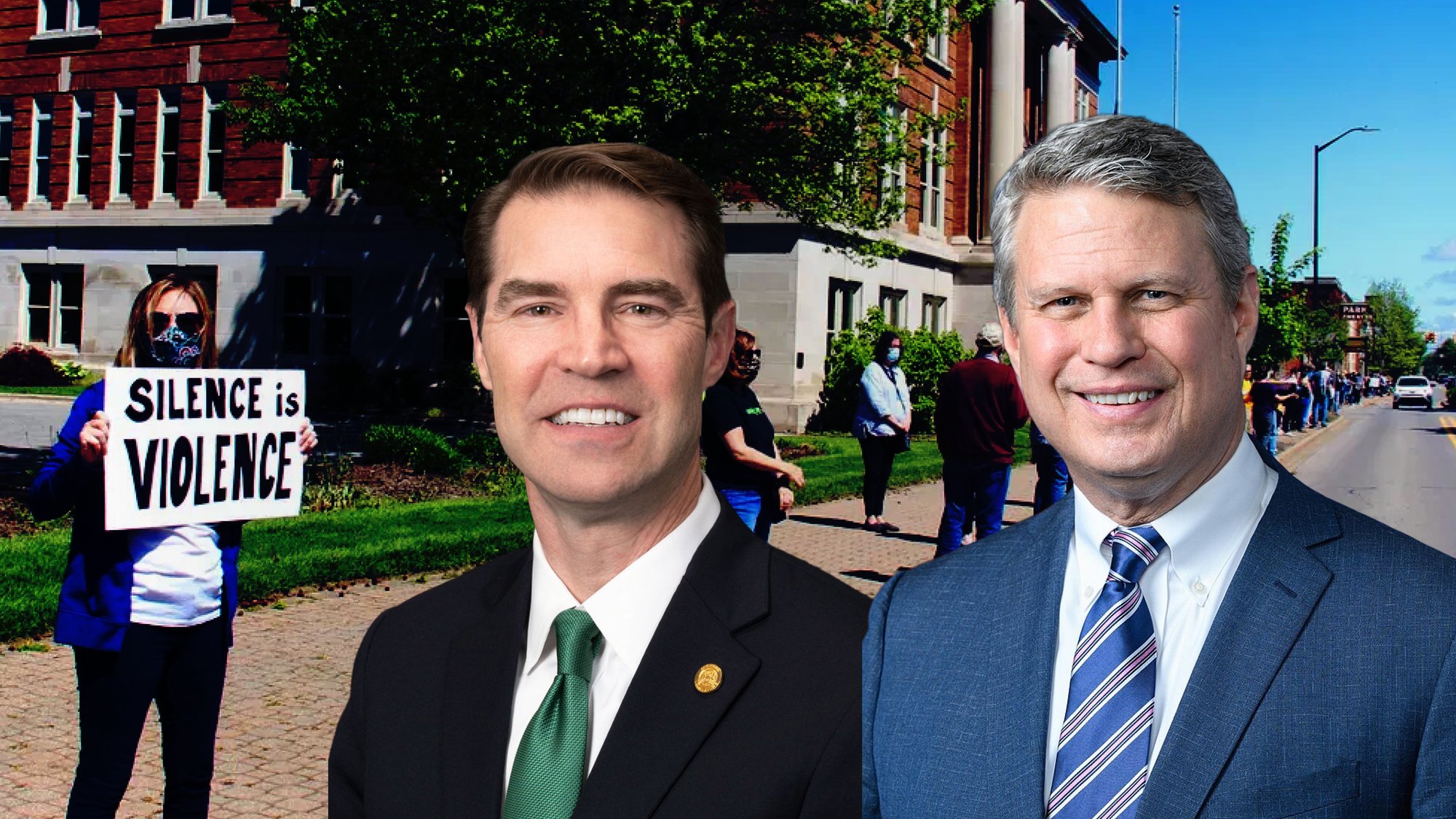
HOLLAND — On free speech, gun rights and taxes, U.S. Rep. Bill Huizenga has spent his time in Congress pushing in one direction: fewer government limits on what Americans can say, what they can own and how much of their paycheck they keep. His Democratic opponent in Michigan’s 4th Congressional District, state Sen. Sean McCann of Kalamazoo, has voted the other way on guns and wants to bar corporations and nonprofits from spending money in Michigan elections. On taxes, his record is mixed.
Huizenga, of Holland Township, has served in the House since 2011. McCann represents the 19th Michigan Senate District. The two face each other on the Nov. 3 ballot.
Huizenga has made government censorship a focus. In June 2025 he introduced H.R. 3719, the Restoring American Freedom Act. It would bar the State Department from using taxpayer money to limit Americans’ speech or to fund outside groups that “blacklist” Americans. Two months earlier he chaired a Foreign Affairs subcommittee hearing titled “Censorship Industrial Complex: The Need for First Amendment Safeguards at the State Department.”
“The federal government should not be censoring the speech of Americans, and they sure as heck shouldn’t be using taxpayer dollars to pay outside organizations to do it either.” — Bill Huizenga, June 5, 2025
In 2023 he voted yes on the Protecting Speech from Government Interference Act (H.R. 140), which bars federal employees from pressuring platforms to censor speech. In 2021 he and other members of a House Republican task force wrote to Twitter’s CEO about the treatment of conservative users. He said the company should perhaps lose its Section 230 liability protections if it did not apply its rules equally.
McCann’s main proposal on political speech goes the other direction. In July 2026 he introduced bills and joint resolutions, modeled on “The Montana Plan,” that would declare that corporations, nonprofits and limited liability companies do not have the power to spend money for or against a candidate, political party, political committee or ballot question in Michigan. The joint resolutions would write that rule into the state constitution. McCann says the goal is to counter the 2010 Citizens United v. FEC ruling and the “dark money” he says it unleashed.
“Citizens United was a terrible ruling that opened the floodgates to dark money in politics.” — Sean McCann, July 6, 2026
In that case, the U.S. Supreme Court held that “the Government may not suppress political speech on the basis of the speaker’s corporate identity.” The court described the group that brought the case, Citizens United, as a nonprofit corporation. McCann’s plan would cover nonprofits by name. No record was found of McCann sponsoring or voting on bills about government pressure on social media platforms.
Huizenga calls himself a responsible gun owner, and his votes back that up. In 2017 he voted yes on the Concealed Carry Reciprocity Act (H.R. 38). It would let people licensed to carry a concealed handgun in one state carry in others, and it included changes to reporting for the federal background-check system.
“The Second Amendment is one of the most fundamental rights we have in this nation.” — Bill Huizenga, Dec. 6, 2017
He has voted against new federal gun restrictions. He voted no on universal background-check bills in 2019 and 2021 (H.R. 8), no on the Enhanced Background Checks Act (H.R. 1446) in 2021, and no on a House-passed assault weapons ban (H.R. 1808) in 2022. That year he also voted no on the Bipartisan Safer Communities Act, which became law. In a 2016 floor statement he put it plainly: “Responsible gun ownership is not the problem!”
McCann says he supports “gun-violence prevention while promoting responsible gun ownership.” In the Senate, he voted for Michigan’s 2023 background-check, safe-storage and red-flag laws, all of which took effect:
“Gun violence is a uniquely American problem, and it is well past time that Michigan Legislature took action to help prevent gun violence.” — Sean McCann, April 6, 2023
Huizenga has voted for both of the major federal tax cuts of the past decade. He voted yes on the Tax Cuts and Jobs Act in December 2017 (227-203; final House vote, 224-201). His office said the law would nearly double the standard deduction and double the child tax credit.
In 2025, when those cuts were set to expire, he voted yes on the One Big Beautiful Bill Act, both on House passage (215-214) and on the final vote (218-214). The first vote passed by a single vote. His office said the law made the 2017 tax cuts permanent and added deductions for tips and overtime pay. In a May 2025 newsletter he said he had championed a deduction for interest on new car loans.
“Today, Congress delivered on the promises President Trump and House Republicans made to the American people to stop the largest tax increase in our nation’s history.” — Bill Huizenga, July 3, 2025
McCann has voted for some tax relief. In 2023 he voted yes on House Bill 4001 (Feb. 1 and Feb. 16). That law phases out limits on deducting retirement income and raises the Working Families Tax Credit from 6% to 30% of the federal earned income credit. He also voted yes on a similar retirement-tax repeal, Senate Bill 1 (23-15). In October 2025, three months after Huizenga voted for the federal tip and overtime deductions, McCann voted for state income tax deductions for tips and overtime (House Bill 4961; 22-14).
But when Republicans offered a cut in the income tax rate itself, McCann voted no. In 2022 he opposed House Bill 4568 (22-14), which would have cut the state rate from 4.25% to 4.0% and expanded several credits. The governor vetoed it.
In October 2025 McCann also voted for the road-funding package (Senate votes, Oct. 3, 2025):
Election Day is Tuesday, Nov. 3. Polls are open 7 a.m. to 8 p.m. Early in-person voting runs through Sunday, Nov. 1. To find your polling place, check your registration or see your sample ballot, visit michigan.gov/vote.
Photos courtesy of the Office of U.S. Rep. Bill Huizenga and the Michigan Senate Democrats.

Copyright © 2025 Hollander Media. All Rights Reserved. This material may not be published, broadcast, rewritten, or redistributed without written authorization. By providing your email or phone number, you are consenting to receive emails, calls, and SMS/MMS messages from The Hollander and affiliates. Msg & data rates may apply.