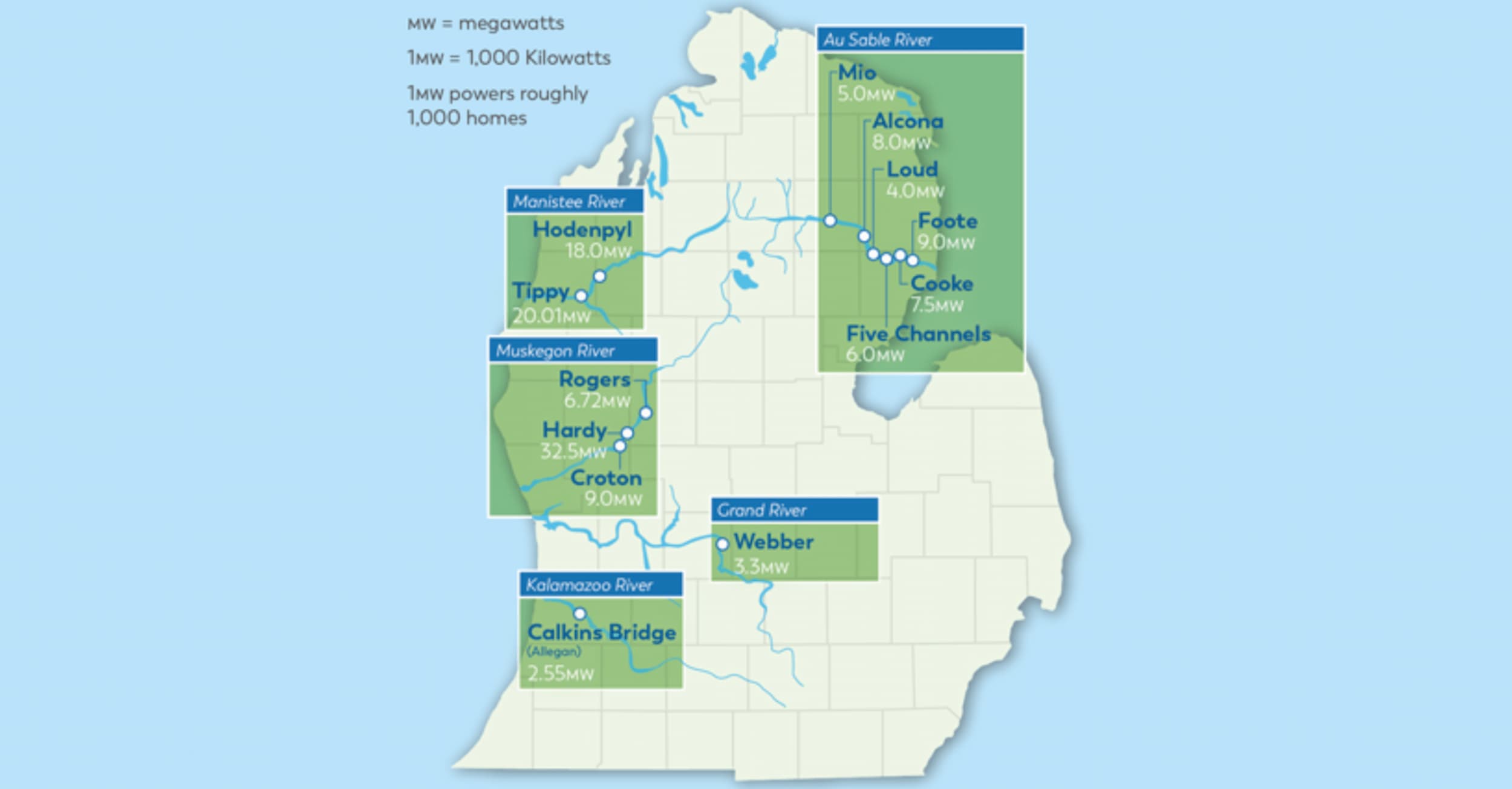
In Michigan, hydroelectric power dates back to the late 1800s. Between 1906 and 1935, Consumers Energy, formerly called Consumers Power, capitalized on this energy source by building 13 hydroelectric dams along five Michigan rivers: Muskegon, Au Sable, Manistee, Grand, and Kalamazoo Rivers. In those early days, hydroelectric power was considered a key component to the electric grid.
Now Consumers Energy (CE) is in the process of selling its 13 dams to Confluence Hydro, pending approval from the Michigan Public Service Commission (MPSC) and the Federal Energy Regulatory Commission (FERC). Michigan residents and the Natural Resources Commission have expressed concerns.
In November and December of 2025, CE and Confluence Hydro held community meetings throughout Michigan to inform residents of their plan for the dams and to answer questions.
According to Rick Blumenstock, Executive Director of Engineering at CE, renewable energy provides 30% of our electricity (of that, hydro is 1%), natural gas provides 31%, power purchase 7%, energy storage 9%, oil/gas 10%, and energy waste reduction 13%.
With the operating licenses for the 13 dams due to expire over the next 9–16 years, CE completed a multi-year review and discovered that Hardy Dam will require $360 million worth of repairs. CE took a step back to consider how hydro fits into the future generation portfolio, especially given that the current contribution to the grid is less than one percent.
A consultant was hired who then determined it was more cost effective to sell rather than to decommission or continue to operate. After vetting several potential buyers, CE chose Confluence Hydro. The deal would include a purchase price for the dams of $1 each, plus a power purchase agreement of 30 years—where CE would agree to purchase every megawatt that is produced by the facilities that Confluence would own. Also included in the sale would be 32,000 acres of land that fall within the park boundary, much of which currently is submerged.
CE’s electric customers would be the ones to pay for the power purchase agreement. The first five years, the customer rate would go up 0.07 cents. Customers currently are paying 16 cents per kilowatt hour and that rate would go up 1/15th of a penny per kilowatt hour.
Residents near the dams who attended the community meetings voiced concerns about their tax base, their way of life, the way they recreate on the water, and whether a new owner would be safe and responsible with the aging dams.

Also concerned over the sale of the dams, was the Michigan Natural Resources Commission (NRC) who invited representatives from CE and Confluence Hydro to share about the sale and answer questions at the April of 2026 NRC meeting.
Blumenstock, along with representatives from Confluence, gave an update and answered questions posed by the NRC, most of which came from Commissioner Brandon Fewins.
Fewins said as he understands it, the dams combined bring in about $13.3 million worth of revenue and cost about $13 million to operate, leaving a slim margin of $300,000 in profit. And then there’s the upcoming hundreds of millions of dollars’ worth of upgrades. The math begs big questions about financial viability. Though Fewins could see the business sense in separating out the 13 LLCs, from a natural resources standpoint and with good conscience, he said selling to Confluence would be “bad for the State of Michigan and our natural resources” and not the right option for Michigan.
How will Confluence be able to continue the dams when CE couldn’t, Fewins wanted to know. Blumenstock explained that CE can make this work but that the cost of the Hardy Dam repairs led them to select the option to sell, which is a lower cost than decommissioning or relicensing. Even when commissioners pressed that they couldn’t understand the math as to why Confluence would be able to continue and not CE, Blumenstock stuck by his answer that selling was a lower cost option.
A commissioner pointed out that by having the dams under CE’s ownership and regulated by the Public Service Commission, CE is responsible to the MPSC, which is responsible to the people of Michigan. Confluence would not be. Confluence will be largely unregulated by or responsible to the State of Michigan and would only be held to federal regulation, which is “a bit on the weak side.” The danger the commissioner saw was with residents no longer being protected.
Questions then were directed to the representatives from Confluence.
Fewins talked about a growing trend with private equity companies coming in and buying infrastructure, mining it for its assets, flipping it, and then getting “the heck out of town.” He asked how many dams Confluence has purchased and currently owns. Jillian Lawrence, COO of Confluence, shared that under Confluence’s ownership, there have been 47 dams, two of which currently still are owned. The rest were sold to, and continue to be owned and operated by, LS Power.
Next, Fewins asked about the licensing, wondering if Confluence would be obliged to operate the dam or required to produce energy under the federal regulatory license. And if not, would the company have to surrender its license and decommission the facility? If it did, he said there would be nothing to stop a new owner from decommissioning and no obligation to produce energy. And if it became more profitable to decommission, get rid of a dam, and sell off 20,000 acres, he wondered if that would be fully within the right of the corporation.
Lawrence said that probably would be within the rights, but that it would not be Confluence’s intention—nor does the company have a demonstrated track record of doing so. Rather, Confluence’s goal is to “revitalize the hydropower industry.” Fewins countered that Confluence in fact has a demonstrated track record of purchasing and selling.
Those transactions, Lawrence explained, were under a different business model. They weren’t partnered with a power purchase agreement, which is what Confluence would have with CE and would keep the company here.
Fewins continued that companies like Confluence change when they’re sitting on top of 30,000 acres of land, and suddenly the value of the company isn’t the purchase agreement but rather the land that can be developed. He added that once CE had washed its hands of the dams and Michigan had limited control, anything could happen. When Fewins discovered that Confluence only had held onto previous dams for a few years, he thought the same would happen with the CE dams.
Lawrence claimed that the idea Confluence would be gone in two or three years didn’t align with the investment thesis for these facilities, and that there are no plans to divest the land. Fewins asked if the other 47 dams came with substantial land like this. “They came with land,” Lawrence said.
Michigan DNR Director Scott Bowen spoke next, explaining that the DNR never has intervened on an MPSC case before. Bowen called the selling of the dams “particularly troublesome,” in that there is a history of private equity firms mismanaging dams in the state. He invited CE to remain the dam owners.
Clearly not in support of the sale, it was announced that the Michigan Natural Resources Commission would be submitting a resolution to the MPSC opposing the proposed sale of the 13 dams.

Do CE’s plans to sell indicate that hydropower is becoming obsolete? One might think that looking at Governor Gretchen Whitmer’s “MI Healthy Climate Plan.” The plan states that in order to meet “climate goals,” Michigan needs to “increase the adoption of wind and solar generation, increase energy waste reduction, invest in grid infrastructure and planning, and ensure that all of these actions are done in a manner aligned with environmental justice.”
But wait, isn’t hydropower a renewable energy? And didn’t President Trump call hydropower “fantastic”? In the not-so-distant past, hydropower even was considered the lowest cost source of energy worldwide.
Including the 13 CE dams, Michigan has a total of 99 hydroelectric dams throughout the state. There is one hydroelectric facility that CE will continue to own with DTE: the Ludington Pumped Storage Plant.
The Ludington Pumped Storage Plant was built “to act as a big battery to store energy from nuclear power plants and level the load for the bulk electric system.” Other types of plants such as nuclear and coal, aren’t able to efficiently stop and start as needed. The pumped storage facility supports peak demands to the grid and when demand is low, moves water uphill to be stored. When its needed, it only takes minutes for the plant to release the water downhill and generate electricity.
Likewise, the second biggest dam in the US, the Bath County Station in Virginia, stores energy off the grid and even has been called the world’s largest "battery.“ The Station has a volume of water called the "power pool" that is pumped to an upper reservoir that is used to generate electricity.
Storing energy to supply the grid? There has been a lot of discussion on that lately with the battery energy storage systems moving in on agricultural land. Facilities like Ludington Pumped Storage Plant already are in place. Any disruption to the fish and environment already has happened. No land needs to be sacrificed.
And then there’s Grand Coulee in Washington, which is the biggest hydroelectric dam in the US. Compared to CE which states that less than 1% of our grid is supplied by the dams, Grand Coulee provides 35% of the entire power supply of the whole Pacific Northwest. And there are no plans to phase out this energy source. On the contrary, the owner, BPA, is seeing “record levels of requests to integrate new renewable generation into the grid” and calls the dam a “critical piece” to the power system.
So, it appears hydropower is not obsolete but rather might be underutilized in our state where the governor seems to prioritize other forms of renewable energy. Additionally, selling to private equity does not seem like a promising path to raising the percentage on how much hydropower feeds the grid.
With solar and wind being weather-dependent and seemingly unreliable, should more effort be put into maintaining hydroelectric facilities as other states, with lower energy rates, are doing, especially since the hydroelectric facilities already are in place? Add those reasons to the NRC’s concerns that the sale of the dams will result in a lack of State oversight, that there’s no long-term history of Confluence’s owning dams, and no guarantee of what could happen to the 32,000 acres of land. Is Michigan, with all of its water sources, overlooking some potential?
At the end of October 2025, CE and Confluence Hydro filed with the MPSC and FERC for approval of the sale. It is expected to take 12 to 18 months to receive the responses.
In the meantime, Michigan residents are invited to submit a comment to the Michigan Public Service Commission on the issue of the dam sale.

Krista Yetzke is a native of Ottawa County. A jeep-driving, guitar-playing wife, mom, and everyday adventurer, Krista was raised on the love of Jesus, the great outdoors, the arts, the value of frugality, and the beauty of food as medicine.
Copyright © 2025 Hollander Media. All Rights Reserved. This material may not be published, broadcast, rewritten, or redistributed without written authorization. By providing your email or phone number, you are consenting to receive emails, calls, and SMS/MMS messages from The Hollander and affiliates. Msg & data rates may apply.