.jpg)
Hundreds packed into the Blendon Township hall Monday night, January 5th, to speak their opposition to the battery energy storage system (BESS) either through public comment or by their presence. The topic was a mere bullet point on the agenda but translated into two hours of debate, with frequent outbursts from an impassioned crowd.
Up for vote was a motion of whether the Planning Commission should express intent to grant six exemptions currently requested by Key Capture Energy (KCE), the BESS developer pursing a proposal for a 12-acre, 100-megawatt lithium-ion phosphate storage facility. Andrew Moore, Township Planner, clarified that granting the exemptions would not mean approving the entire project. Rather, it would allow the process to continue in front of the Planning Commission.
As a refresher from last month's meeting, Moore explained that if the Planning Commission decided that the Zoning Board of Appeals (ZBA) should be the board to make the exemption decisions, most likely the ZBA would deny the requests and KCE would be “forced” to bypass the township and apply to the Michigan Public Service Commission (MPSC). And if the ZBA did grant the requested variances, the application would come back to the Planning Commission for more of the same conversation as had been discussed the last two months—consuming a lot of time and money in the process. Moore encouraged the Commission to grant the exemptions.
The crowd reacted to Moore's recommendation, challenging the commissioners to think for themselves and protect their agricultural community.
Chair Mark Leathead brought the room back to order.
Moore responded to the residents saying that "such are the facts and circumstances surrounding PA233," the Public Act signed by Governor Whitmer that rolled out the welcome mat to energy companies and put them in what Moore called a “very privileged position.” The Township, on the other hand, was put in the “worst possible position,” with minimal control over KCE's application but all of the responsibility.
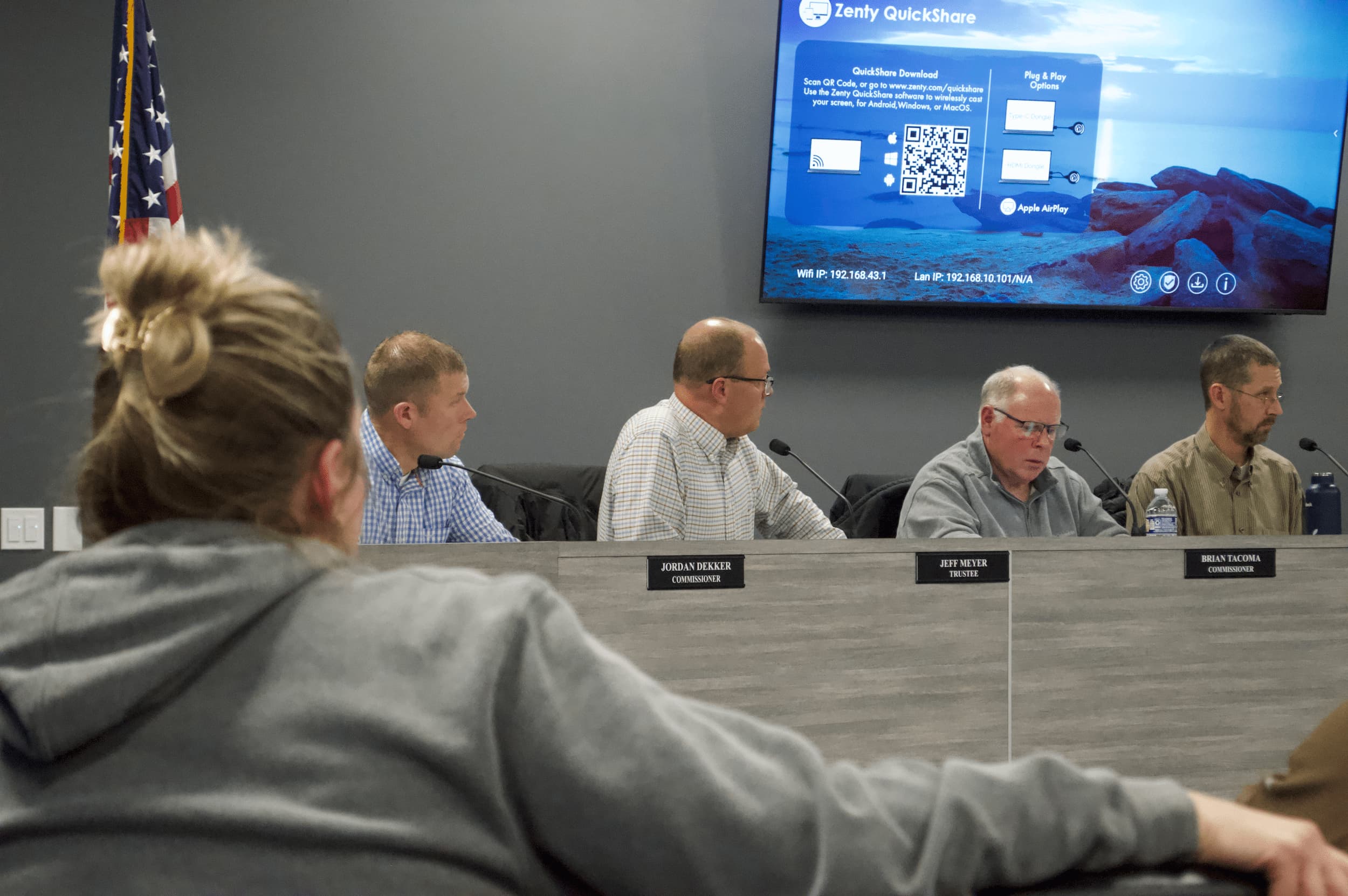
Chair Leathead expressed that he didn’t want the BESS “at all.” He said he doesn’t like that the MPSC is a three-person board put in place by Governor Whitmer, and that they all "worship at the net-zero emissions alter.” (The statement garnered applause.) He also wasn’t comfortable with KCE’s proposal, saying he wanted to see the money up front and to get information from those working at KCE’s 14 current sites around the country. He assured residents that nothing had been decided, and that he does know what’s best for the township—which would be for KCE “to go back to New York.”
But Chair Leathead followed with: “That’s just not going to happen. You’ve got to deal with the facts and reality… The state’s saying, ‘You’re going to do it our way or you’re going to do it our way.’” He added that the Planning Commission is trying to make the best situation it can from a very bad situation.
The residents weren’t having it. “Just tell them, "No,'” one called out.
Others wanted the commissioners to let KCE go to the MPSC so they then could engage in a new fight—with the MPSC. Another wondered how it would be any different if KCE applied to MPSC, saying that the Commission doesn’t have any say now anyway.
One asked whether the property owner, Jordan Dekker, who had leased his land to KCE, could pull out of the deal. Another in the crowd answered that he couldn’t; he had signed the contract. (Dekker, who sits on the Planning Commission board, had recused himself during the discussion due to the conflict of interest.)
Bev Horinga, one of several local residents who has shown up meeting after meeting with an arsenal of oppositional data, fired off a litany of information on the MPSC. Namely, that the state is given a year to decide and, as of yet, has not approved a single application. The energy companies that have been sent to the state have withdrawn their applications. Also, the state requires studies, analysis, engineering documents, public notices, various testing, and so forth. If an application is incomplete, a deficiency notice is issued which leads to hearings and the gathering of evidence and testimonies. And there are fees, costly fees.
A realtor in the crowd sought another angle, telling the commission that a BESS will devalue every single person's property. The people will not want to build, buy, or live there. It is a safety hazard.
The Chair responded that PA233 doesn’t care about residents no longer wanting to live in Blendon.
“But you should,” a resident called out.
“This is a situation where elections have consequences,” Chair Leathead said. Ironically, his point was the same that many residents were trying to make. For the Chair, he appeared to mean the Commission had little option because of Governor Whitmer. On the contrary, several residents voiced that Governor Whitmer’s term was coming to an end and PA233 could be overturned.
After more discussion on the exemptions and a reiteration that the granting of the exemptions did not mean project approval, the vote was taken.
The motion to express intent to grant some of KCE’s requested exemptions, passed, 4–1. Ben Van Zweden was the only one to vote against the motion.
The BESS topic wound down with no clear winners and all seeming frustrated—residents frustrated by commissioners who weren’t appearing to hear or represent them, commissioners frustrated by a lack of information and control in their decisions, and KCE frustrated by yet another meeting with barely any progress on the application.
At the rate the process is taking, could both the Planning Commission and the opposing residents get what they appear to want?
If the commissioners can drag out the determination until a new governor is elected, might PA233 be removed along with the board’s burden of decision?

Krista Yetzke is a native of Ottawa County. A jeep-driving, guitar-playing wife, mom, and everyday adventurer, Krista was raised on the love of Jesus, the great outdoors, the arts, the value of frugality, and the beauty of food as medicine.
Copyright © 2025 Hollander Media. All Rights Reserved. This material may not be published, broadcast, rewritten, or redistributed without written authorization. By providing your email or phone number, you are consenting to receive emails, calls, and SMS/MMS messages from The Hollander and affiliates. Msg & data rates may apply.