HOLLAND, Mich. — Joseph McClusky’s campaign for Michigan’s 86th House District presents a personal story built around family, faith and his decision to make West Michigan home.
His campaign biography talks about his parents. It says they raised him with a strong Christian faith and three values that have stayed with him: work hard, tell the truth and love your neighbor. It describes his years at Hope College and his decision to remain in Holland after graduating. It also points to his work with community organizations and political groups as part of the path that led him to run for office.
What the campaign biography does not mention is McClusky’s husband.
McClusky married Stephen Rumler on Sept. 16, 2023, at Grace Episcopal Church in Holland. A copy of the couple’s wedding program is preserved in the Holland Museum collection, according to the museum record reviewed by The Hollander. The program identifies the ceremony as the marriage of Stephen Rumler and Joseph McClusky and names relatives from both families who participated.
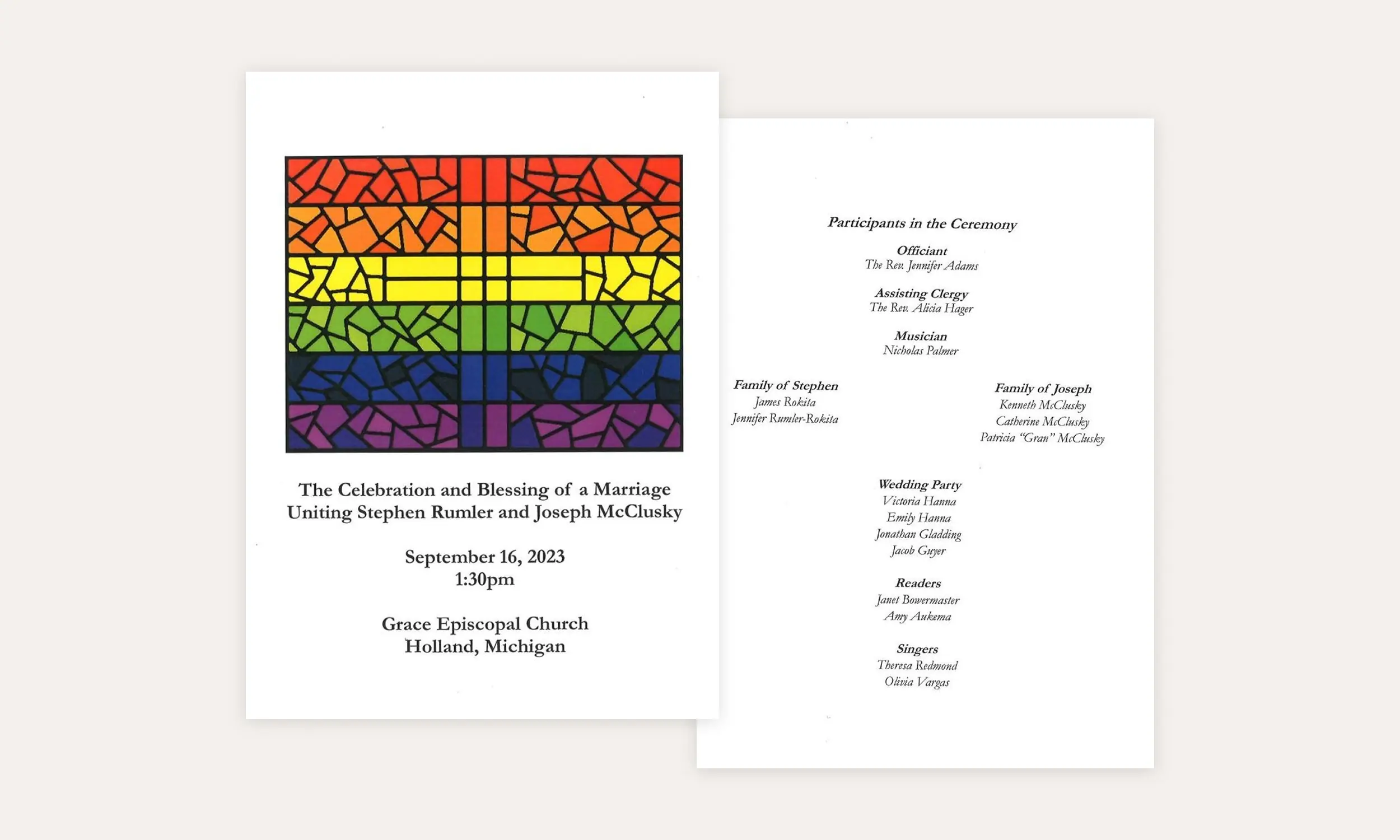
The museum record also identifies McClusky himself as the donor of the wedding program.
That makes the marriage neither secret nor difficult to document. It is part of a public museum collection in the same community McClusky is now asking to represent.
Stephen now uses the name Stephen Rumler-McClusky professionally. Hope College lists him as an accompanist in its Dance Department, where he has worked since fall 2022. The college says he provides piano accompaniment for ballet, modern, repertory and improvisation classes. Hope also says he earned a bachelor’s degree in music from Aquinas College in 2020.
Rumler-McClusky has another direct connection to Holland. Hope College says he has served as director of music at Grace Episcopal Church since fall 2021. That is the same church where he and McClusky were married two years later.
He later worked at the Holland Museum, where the museum’s 2022-23 annual report listed him as development and communications associate director. His husband works at Hope and directs music at Grace Episcopal. Their wedding took place at Grace Episcopal, and the program from that ceremony was later added to the Holland Museum collection.

McClusky’s website says he chose to stay after graduating from Hope because the community had helped shape him. It describes his candidacy as an effort to “give back to the community that has given so much to me.”
His campaign also uses his family background to explain his politics. McClusky says his father suffered an injury that disrupted the family’s finances and that his mother took a job as a school lunch worker to help make ends meet. Michigan House Democrats similarly describe his campaign as rooted in faith, service and the lessons he learned from his parents. (Michigan House Democrats)
As of Sept. 25, however, McClusky’s campaign “About Joseph” page discusses his parents, upbringing, faith, education and professional experiences without mentioning Stephen or the couple’s marriage.
That omission stands out because other parts of McClusky’s public record are open about his identity. A third-party candidate profile describes him as having come out as gay while attending Hope College, and LGBTQ+ political organizations have publicly supported his candidacy.
What the public record does not establish is why his campaign has chosen not to include his husband in its biography. Privacy, campaign strategy or simple editorial choice are all possible explanations.
McClusky has chosen to make his parents, upbringing, Christian faith and family financial struggles part of the story presented to voters, while his marriage is absent from that same biography.
That contrast is notable because the marriage itself is already public. McClusky donated the wedding program to the Holland Museum. Rumler-McClusky appears in Hope College’s current directory, and his Hope profile publicly identifies his role at Grace Episcopal Church.
McClusky is running on a platform he summarizes as “Affordability. Accountability. Action.” His campaign says public officials should answer directly to constituents and argues for greater transparency in state government, including stronger public-records requirements for the Legislature and governor’s office.
Those positions concern government transparency, not a requirement that candidates disclose every aspect of their private lives. Marriage is not a qualification for office, and candidates are entitled to draw boundaries around personal information.
But campaigns also decide which parts of a candidate’s personal life become part of the public story.
In McClusky’s case, his parents are part of that story. His childhood is part of it. His Christian upbringing, Hope College years and decision to stay in Holland are part of it.
His husband, so far, is not.

Copyright © 2025 Hollander Media. All Rights Reserved. This material may not be published, broadcast, rewritten, or redistributed without written authorization. By providing your email or phone number, you are consenting to receive emails, calls, and SMS/MMS messages from The Hollander and affiliates. Msg & data rates may apply.