Victory, who is term-limited from seeking another term in the Michigan Senate, is now running for the Michigan State University Board of Trustees. A fourth-generation farmer from the Hudsonville area, Victory owns Victory Farms and Victory Sales and has represented portions of Ottawa and Allegan counties in the Michigan Senate since 2019 after serving six years in the Michigan House of Representatives. He currently serves as Senate Republican Caucus Whip.
The discussion focused on issues affecting Michigan agriculture, including permitting delays, workforce shortages, food processing, state regulations, farmland preservation and the relationship between farmers and state government. Representatives from Michigan's asparagus and food processing industries, meat processors and agricultural organizations participated in the conversation, along with congressional candidate Terri DeBoer.
Victory opened the discussion by describing one of his priorities as helping businesses work through state government.
"My main goal now is trying to get the departments to solve the problem, so [that] agriculture or any other industry can thrive," Victory said. "We can't [have] businesses sitting on the sidelines waiting for a permit or an agency to get us the okay to move forward."
Several participants echoed concerns about regulatory certainty, labor challenges and processing capacity, saying multi-generational businesses need greater predictability from state agencies to continue investing in Michigan agriculture.
As the roundtable concluded, Victory emphasized agriculture's role in Michigan's economy.
"Agriculture is critical to Michigan's rural economy," Victory said. "I always say it's a three-legged stool. We have agriculture, manufacturing and tourism, and those are the three drivers of our economy."
Victory said Michigan's agricultural industry benefits from the state's abundant water resources and diverse crops but argued that farmers continue to face unnecessary regulatory obstacles. He specifically criticized the Michigan Department of Environment, Great Lakes, and Energy (EGLE), saying producers have struggled with permitting and regulatory delays. He also pointed to industrial-scale solar development on farmland as a growing concern.
"They're taking this precious farmland that we have here... and they're putting solar industrial facilities on it," Victory said. "Once we take that out of production, I don't see it coming back."
Victory also said legislative term limits are resulting in the loss of experienced agricultural voices in Lansing, making it important that Michigan's next governor understands the industry's needs.
"Because of this, I will be endorsing you today," Victory said. "You have my wholehearted endorsement because we need to have a strong voice of agriculture, and you're willing to come to Victory Farms."
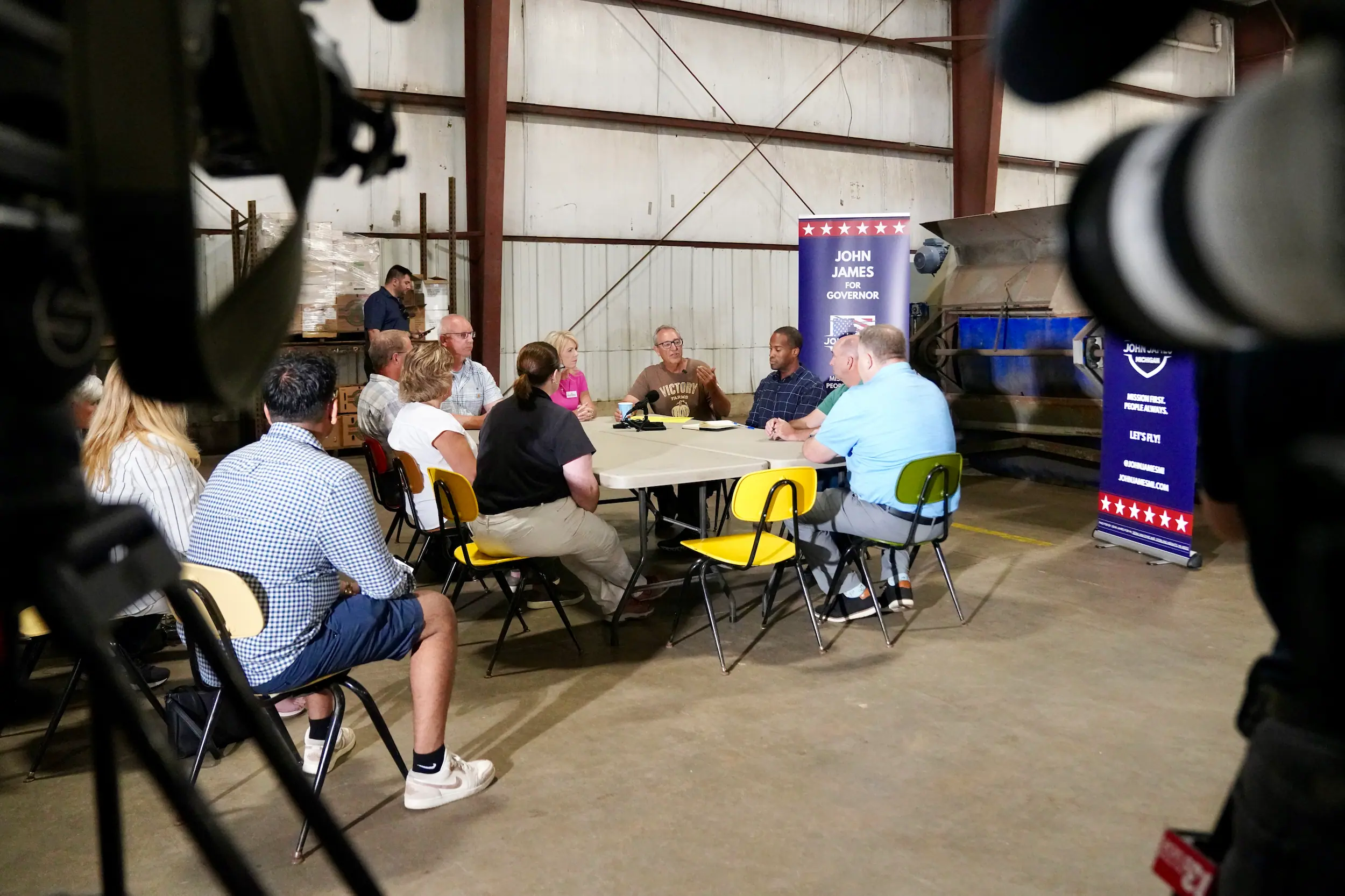
James thanked Victory for the endorsement and said it represented an obligation to deliver results.
"I'm honored to have that endorsement," James said. "That comes with the obligation to do more than talk. That comes with the obligation to do and bring results."

James said he believes farmers and business owners—not state government—are best equipped to make decisions affecting their operations.
"I'm here to learn. I'm here to listen," James said. "I believe very strongly that you know how to run your farms better than government."
During his remarks, James pledged to reform EGLE, streamline state government and work to repeal Public Act 233, arguing that local communities should retain authority over large-scale energy projects and that productive farmland should be protected.
"We're open for business, but we're not for sale," James said. "We can and will grow and diversify our economy, but we will not do it at the expense of our communities."
Victory's endorsement comes as he seeks election to the Michigan State University Board of Trustees, where his campaign has emphasized strengthening the university's land-grant mission, supporting agriculture and Extension programs, and increasing accountability and transparency in university governance.

Eric McKee is a lifetime resident of West Michigan. Married with two energetic boys, he spends his days balancing work with dad life. Also, a firm believer that Almond St. Claus Windmill Cookies are the ultimate snack (and maybe a little too good).
Copyright © 2025 Hollander Media. All Rights Reserved. This material may not be published, broadcast, rewritten, or redistributed without written authorization. By providing your email or phone number, you are consenting to receive emails, calls, and SMS/MMS messages from The Hollander and affiliates. Msg & data rates may apply.