Zeeland Township planning commissioners seem to have listened to their residents. So far, they have held their ground against the land-hungry solar developer RWE.
Last Tuesday evening, March 10th, the Commission met in front of a fraction of the crowd that has been attending in recent months. With the trajectory of the Planning Commission to create an “incompatible workable” renewable energy ordinance, it appeared most residents will be redirecting their pleas to the current solar applicant, RWE.
RWE will host three public meetings to receive the public’s comments on the site plan, which can be found on the developer’s website. To send written comments prior to the public meetings, email Joseph Brochu at silvermaplesolar@rwe.com.
To address RWE in person, plan to attend one of the following public hearings:
Date: Tuesday, March 17th
Time: 6:00. pm
Location: Evergreen Ministries, 4512 48th Ave., Hudsonville
Date: Wednesday, March 18th and Thursday, March 19th
Time: 6:00 pm
Location: Zeeland Township Hall, 6582 Byron Road, Zeeland
Even though RWE plans to bypass the township, the Zeeland Township Planning Commission spent last week's meeting continuing to revise its renewable energy ordinance.
Township Attorney Dave Eberle recapped that Michigan's Public Act 233 offers the Township two options: either create a compatible renewable energy ordinance that would require energy companies to permit locally or adopt an incompatible workable ordinance that would allow a developer to go to the State but still would be sufficiently workable to permit locally.
Planning Commissioner Linda Walker clarified that either the commissioners fight and try to protect the farmland, or they give it to RWE. If they fight, RWE will go to Lansing and get the land, but the process will be delayed.
As PA 233 stands now, if a developer bypasses a township and goes to the State, there will be a contested hearing before the MPSC—with the township having to argue why changes should be made. While some standards might be considered, in the end, it's a decision by the MPSC.
Additionally, according to PA 233, for a project to go through the MPSC, it needs to meet a minimum number of megawatts. A small-scale commercial solar project wouldn't have that option. A resident asked whether the ordinance could be written so that if a project was under the megawatts required by the MPSC, it wouldn’t be allowed at all.
Township Planner Lori Castell responded that if something is a legal use, such as solar, you have to make a provision for it to be allowed somewhere in your township. And if you make it so extremely hard that it’s exclusionary, then you can get into trouble for having an exclusionary ordinance.
If PA 233 is repealed, all of these requirements could change.
There currently is active litigation against PA 233 with oral arguments scheduled for April. Eberle expects it will be at least a few months before an opinion is given by the Court of Appeals.
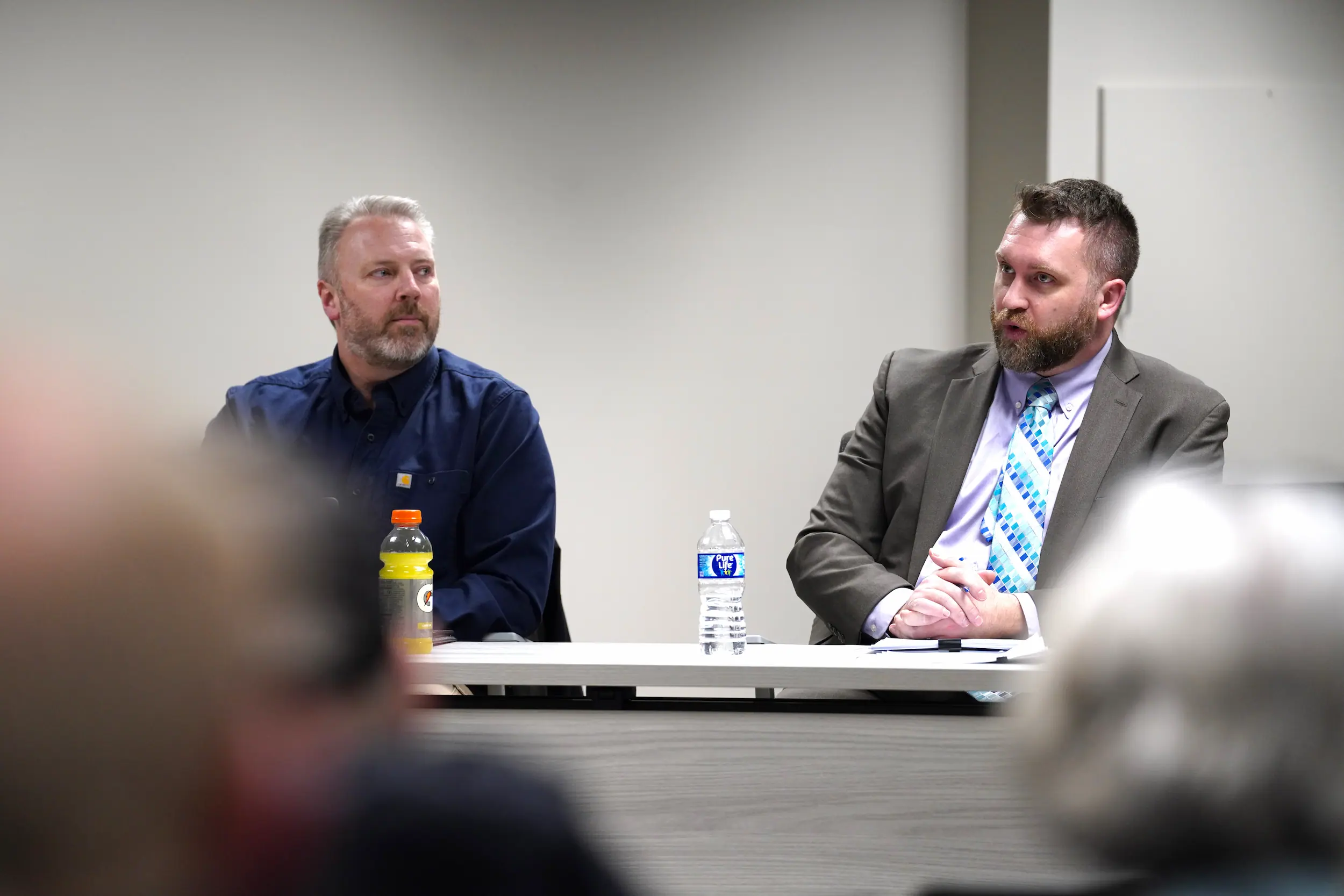
Eberle reviewed the draft changes he had made on request of the Planning Commission.
500 acres
Regarding the Commission's intent to limit energy projects to 500 acres, Eberle said the Township would move forward with the understanding that limiting the acreage is guaranteeing that RWE will go to the MPSC. He added that the decision is valid and would have impact down the road. However, because the requirement is incompatible with RWE's proposal, the Township most likely would need to argue at the hearing that a project of 1900 acres would be utilizing an unreasonable amount of farmland within the county.
As for projects that aren't "PA 233 eligible," the commissioners made the decision to prohibit them within Ag zoning, restricting them to industrial areas or on parking lots only.
Castell suggested adding that if PA 233 is repealed, larger projects will no longer be allowed within Ag zoning.
Glare
Walker spoke of concerns with glare coming from solar panels and how it would affect pilots flying in and out of Ottawa Executive Airport. She projected photos taken while flying over Muskegon’s 250-megawatt, 550,000-paneled facility sprawled over 1900 acres. The photos demonstrated a definite glare even though, as Walker pointed out, it was a hazy day, and the facility was said to have been built with low glare—as RWE claims the Silver Maple project would be.
Drain tile map
Eberle had removed the requirement for a drain tile map. Walker pushed back, explaining that if something were to happen, the information would be good to have on file.
Commissioner Scott Beute said that as he understood it, a drain tile map already is required in PA 233, and anything required by the MPSC that is adequate should be included. “What we don’t want to do,” he said, “is make our ordinance more lenient than what the State would require.” Eberle agreed to add the State language regarding drainage, tile mapping, and soil.
Livestock
The next issue addressed was regarding livestock. Commissioner Dennis Russcher thought the “prime farmland” definition should include information on animal concentration and feed lots. He said one of the biggest concerns is where to go with manure. Currently most of the ground being looked at for the project is under the Manure Management plan Russcher has with EGLE.
Russcher said not being able to send his animals' manure through a hose to the land would really change how he farms. If the land turns into a solar farm, it will take 10,000-gallon tankers to haul the manure off his farm by semi-truck, which will tear up the roads.
Eberle acknowledged the concern and asked the commissioners whether they wanted to address the issue in the ordinance or leave it to the private property owner to figure out. He suggested including space in the ordinance to identify and consider a threshold for livestock density.
When Eberle finished reading through the revisions, Castell was tasked with finding benchmarks to review regarding the Commission's remaining questions. Eberle will implement the changes brought on by the additional concerns and bring a revised draft to the next meeting.
Encouragement
Throughout the draft discussion, Eberle encouraged the commissioners. “At the end of the day,” Eberle said, “the board’s going to make the decision. But you’ve done your job to present clear arguments as to why you made the decision you did, and why you think that's the best decision.”
Eberle told of a recent news article in which an energy developer wasn't able to proceed with a proposal.
The reality is that the developers can only build a project if they get the land.
Developers always can go to the MPSC, but they still have to have land from the landowners. In the referenced article, there weren’t enough landowners who were on board, and it killed the project.
In his closing comment, Commissioner Tim Miedema shared that he’d received emails from the Michigan Township Association regarding several House Bills that would take away more local control when it comes to regulating housing size, duplexes, lot sizes, and more.
Miedema encouraged residents to act, saying the issue is "somewhat urgent," and that the House is trying to push these bills through. He asked residents to visit the Michigan Township Association website—which has links to contact elected officials.
Miedema found it ironic that a project in Ottawa County is looking to cover up 1900 acres in solar panels even though the State knows we need more housing.
One of the final public comments was from a resident imploring all Township board members to read the site plan. He was discouraged that some hadn’t since this is “the biggest issue this township has ever had.” He thanked the commissioners who had been researching. “We’re relying on the Planning Commission to save us.”

Krista Yetzke is a native of Ottawa County. A jeep-driving, guitar-playing wife, mom, and everyday adventurer, Krista was raised on the love of Jesus, the great outdoors, the arts, the value of frugality, and the beauty of food as medicine.
Copyright © 2025 Hollander Media. All Rights Reserved. This material may not be published, broadcast, rewritten, or redistributed without written authorization. By providing your email or phone number, you are consenting to receive emails, calls, and SMS/MMS messages from The Hollander and affiliates. Msg & data rates may apply.


.jpg)