.jpg)
Whether or not we think this is an appropriate time to make sweeping changes to our governing document, the current law dictates that every 16 years voters are given the opportunity to ask for a review of our Constitution. Since it has been 16 years since it last appeared on our ballot, the question will be on the 2026 general ballot asking whether you think it’s time for an overhaul, a.k.a. Proposal One. Passing the proposal would set things in motion for a Constitution Convention, otherwise known as a Con-Con.
Change is good right? If you’re not moving forward you’re sitting still or moving backward, or so we’re told.
Eric Lupher, President of Citizens Research Council, thinks it’s to Michigan’s credit that the Constitution has language that allows voters to check in with how they think things are going with the structure of government, tax limitation, etc. And since voters haven’t approved having a Con-Con since the 1960s, it appears that for the most part, people have been happy with the Constitution.
Our Constitution governs almost everything about Michigan life—rights, elections, education, courts, local government, and legislative powers, death penalty, environmental protections, education structure, tax structure, term limits for law makers. Should we tear open such a thoughtfully and carefully crafted piece of our history and allow a rewrite from scratch? And who is worthy of such a task?
Those who support having a Con-Con say we’ve had 39 amendments to the current Constitution already. Let’s update it and clean it up.
Those opposed say it’s too risky to give that kind of vulnerability to our most important document. In the wrong hands, an overhaul could affect not only the direction of the state but our everyday lives.
Since its founding, Michigan has had four constitutions—the Constitutions of 1835, 1850, 1908, and 1963—which is our current Constitution. Since the adoption of the 1963 Constitution, voters have rejected the required 16-year Con-Con proposal every time it has appeared on the ballot.
While the U.S. Constitution only has been amended 27 times since its inception, the Michigan Constitution has had 148 amendments. Meaning, the Michigan Constitution in place today represents Michigan voices from 1835 through 2022, when the most recent amendments were passed. That’s a lot of historical input.
The first Michigan Constitution was drafted in 1835, before we became a state. What stood in the way to statehood, was the disputed Toledo Strip on the border shared with Ohio. We thought it was ours, Ohio residents thought it was theirs, and the Toledo War ensued. Congress offered Michigan a compromise: Give Toledo to Ohio and you can have most of the Upper Peninsula. Though initially rejected, Michigan eventually accepted the compromise in 1837 and was admitted as the 26th state in the Union with its 1835 Constitution.
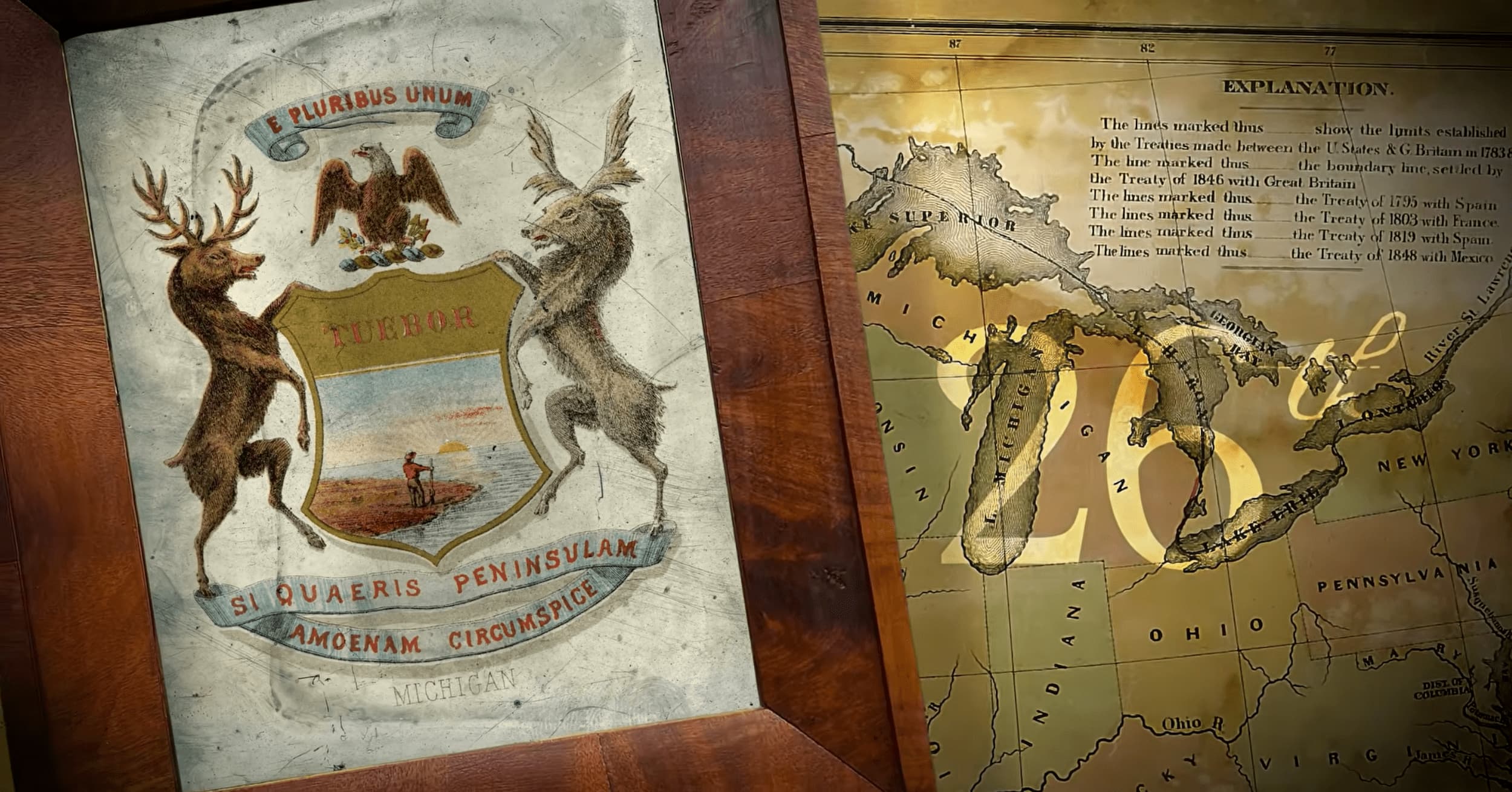
The 1835 Constitution held up until 1850, when it was approved by voters to revise the original framework. The new Constitution restricted the legislative power regarding state fiscal matters, limited gubernatorial appointment power and added articles on county and township government, finance and taxation, and corporations. And it was in the 1850 Constitution, that a provision was added that every 16 years the question of calling a Constitutional Convention automatically be submitted to the voters.
Voters did not approve another Con-Con until more than 50 years later. The result was the 1908 Constitution. This Constitution gave allowances for cities and villages to draft their own charters and incorporate themselves and reinserted Article II Bill of Rights, which the 1850 Constitution had moved to “miscellany.” It also provided general government reorganization, wage and labor law legislation, a gubernatorial line-item veto on appropriation bills, and greater local government autonomy.
1963 was the last time Michigan voters approved a Con-Con. At that time, there had been 69 amendments to the 1908 Constitution. According to Lynn Liberato, author of Michigan’s Con-Con 11, Michigan had gone through a lot of change since 1908, and a rewrite was needed. Once a predominantly agriculture state, Michigan had become a car manufacturing giant. The state was more urbanized and social and had experienced modernizations in technology and healthcare. The 1963 Constitution expanded executive power, capped the number of state departments, created a bipartisan Civil Rights Commission, restructured debt limits, and reorganized higher education governance and local government.
Since 1962, voters have been asked four times (every 16 years) to approve a Con-Con, in 1978, 1994, 2010 and now in 2026. The 1963 Constitution has been amended 39 times, with the most recent three amendments being voted on in 2022.
So, are we to the point we were in the 1960s? Has culture changed to the degree that updating is necessary?
If voters approve a Con-Con, 148 delegates will be chosen to essentially dissect and potentially rewrite the whole Constitution. The 148 would be made up of one delegate from each of the 110 House districts and 1 delegate from each of the 38 Senate districts.
Those aspiring to be a Con-Con delegate will begin campaigning for a primary election which would be held in February 2027 and a general election in May. The Con-Con would convene in October 2027. Candidates could be anyone interested in the process and in serving. They don’t need to be a current delegate. The only stipulation is they can’t currently be serving in the Legislature.
There will be no set agenda, no guardrails, no limit to the number of issues considered, and nothing in the Constitution would be off limits. A rewrite could be of part of the Constitution or the entire document.
According to Lupher, this would be a brand new body that can write bylaws, can elect officers, and can make up how they will do proceedings as they go. There are no rules on timing to get it done. When this happened in 1963, it took about 8 or 9 months—which might be what it would take this time around if it were to pass.
Once a draft is completed, it would be brought to the voters. Lupher said the drafters might make some changes residents like but others they won’t. He gave the example of the topic of Reproductive Rights. The drafters might leave that amendment alone and change eight other articles. Or they might change that amendment and leave everything else alone. It’s a delicate balancing act of compromise that they would need to sell to the voters.
Lupher pointed out that there is no macro issue that says we need to blow up the current Constitution and start over. Rather there are little issues that pop up from time to time that don’t attraction. He said a Con-Con is a way to address those things.
Voters then have the opportunity to pass or fail the draft.
The Small Business Association of Michigan (SBAM) has raised concerns about the process. SBAM points out that Con-Con guidelines are lacking. Article XII Section 3 of the Michigan Constitution merely gives framework to where the delegates need to convene, that they are allowed to choose their own officers and determine their own rules, and that they produce an amended or totally rewritten constitution that goes to voters for approval. No other restrictions are mentioned, no timeline is set, no budget is given, and there is no external oversight. The Constitution also neglects to stipulate campaign finance requirements for the 148 delegates. SBAM questioned whether the omission opens the door for out-of-state dark money to influence the process.
SBAM further states that since the entire Constitution is open, this could lead to everything being up for debate from tax structure to property rights, all within a highly polarized political moment.” Supporters of the Con-Con disagree saying rather it’s an opportunity to streamline subject areas and mechanisms that have become convoluted.
Wendy Block, executive VP of business advocacy for the Michigan Chamber and lobbyist, encourages residents to vote no on Proposal 1, saying that a Con-Con could lead to a ton of chaos. She asked, “[As a delegate], how do you make sure your ‘side’ is successful to convince voters at the end of the day to vote for a constitution people like but also that maybe people hate or really dislike.” Block pointed out that the Constitution is unclear as to what happens with the Legislature during a Con-Con. The Legislature could pass a bill which the delegates could oppose and turn around and do the opposite and enshrine it into the Constitution.
Block added that groups from all political persuasions are saying, “Not so fast, we need to think this through. Vote no.”
On the other hand, Michigan House Speaker Rep. Matt Hall (R-Richland Township) supports the proposal, partly because of the many amendments that have been added to the current Constitution. He added that some of those amendments have caused frustration, and they’re hard for lawmakers to change.
Even without a Con-Con, the Michigan Constitution can be amended through citizen-initiated process or a legislative process, which might be preferred to a total overhaul when in the midst of a somewhat volatile political climate.
Handing the reigns, or in this case the red (editing) pen, over to 148 people who have few guidelines on their election, function, parameters, or scope, seems like an awfully big gamble with Michigan’s historical, governing document. Some might even call the risk terrifying, when considering the potential for disaster.
What do you think? Is this the time for a Con-Con?

Krista Yetzke is a native of Ottawa County. A jeep-driving, guitar-playing wife, mom, and everyday adventurer, Krista was raised on the love of Jesus, the great outdoors, the arts, the value of frugality, and the beauty of food as medicine.
Copyright © 2025 Hollander Media. All Rights Reserved. This material may not be published, broadcast, rewritten, or redistributed without written authorization. By providing your email or phone number, you are consenting to receive emails, calls, and SMS/MMS messages from The Hollander and affiliates. Msg & data rates may apply.