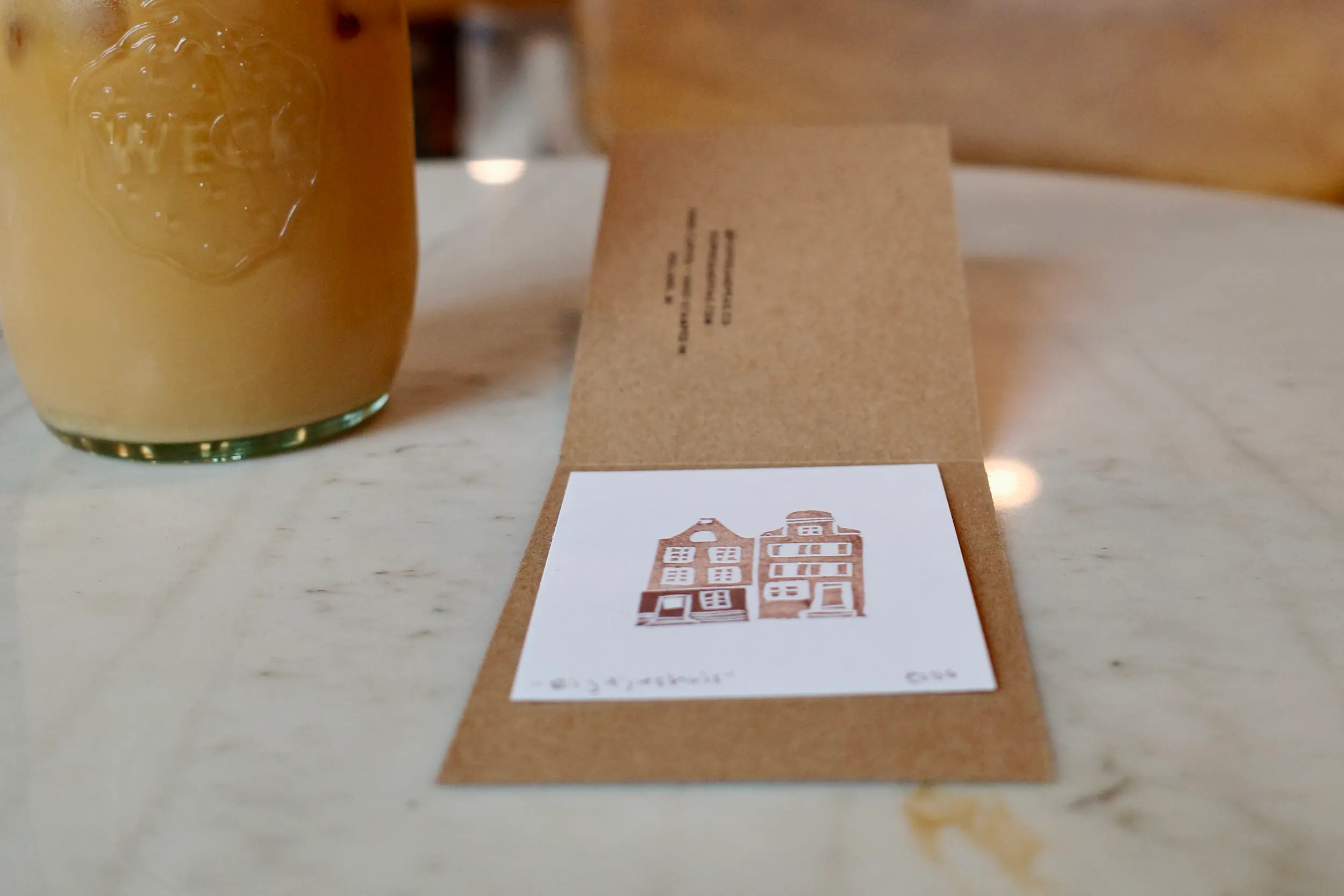
Emilie Goris, boutique farmer-florist and owner of Poppies and Peas, is pushing back against the fast-paced, digital world through her collection of celebratory lino prints. Her love for lino print (a relief printing technique where a design is carved into a sheet of linoleum) began back in middle school. Emilie attended Zeeland Christian School, where she recalls creating her first hand-carved lino print stamp: a praying mantis. Now, as an adult and mom of four, Emilie has rediscovered her love of lino printing. In part, she shared, because it is an intentional, slow process.
The slow art movement celebrates thoughtful, unhurried, and mindful connection with art. Lino printing is often considered slow art. “It takes time to do the carving and the printing, and I think for me, I actually like the way that it can’t be perfect. When you’re carving something, you can start over, but you can’t put the block pieces back once you’ve carved them off,” Emilie explained. “It feels like the design is kind of always evolving,” she added.
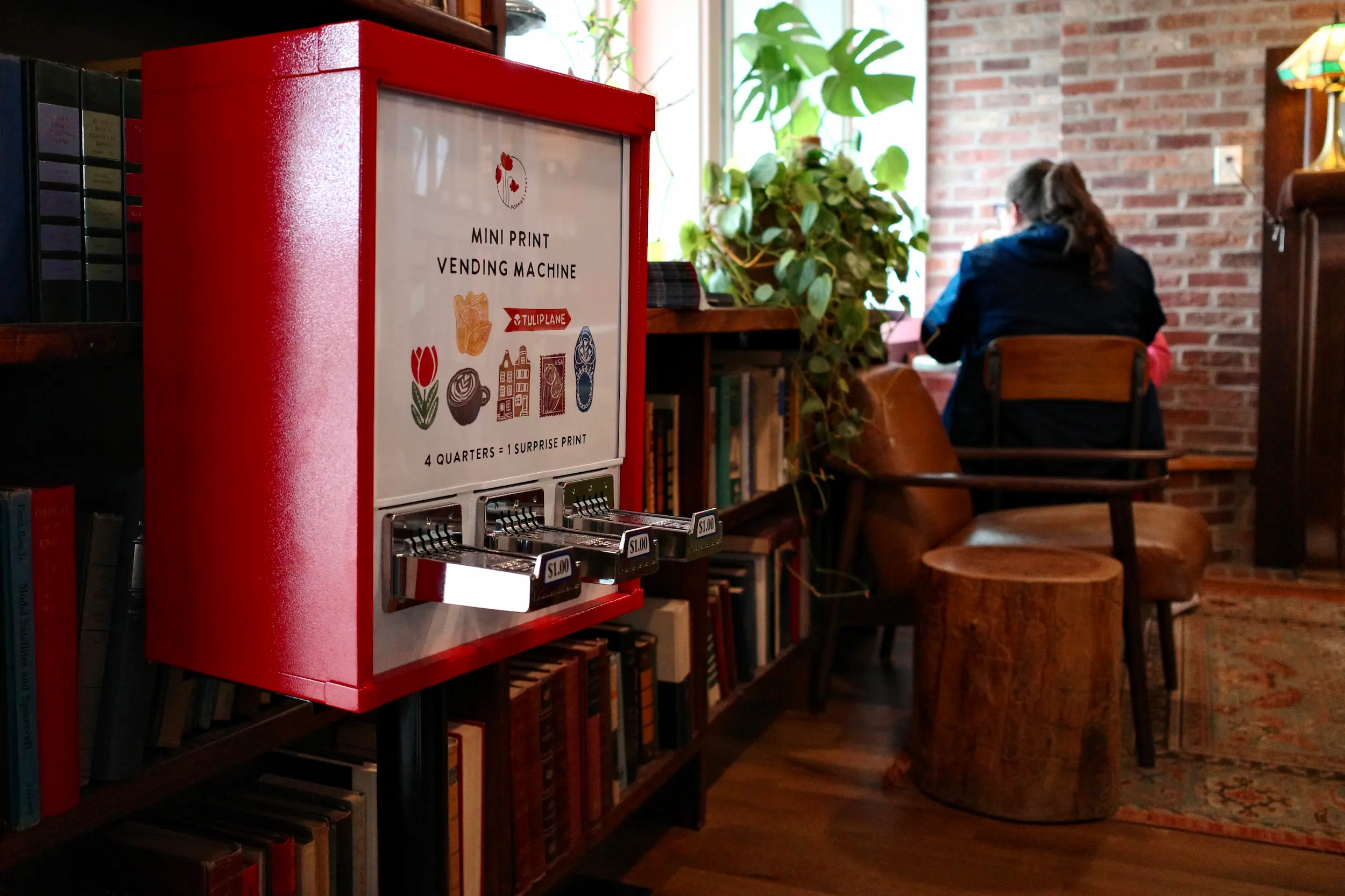
The slow art movement is akin to the slow flower movement, which focuses on locally grown and ethically curated blooms. The slow flower movement prioritizes sustainability and seasonality, along with respect for local ecosystems, something Emilie has been practicing within her boutique flower farm, Poppies and Peas. So, the ideology of slow, curated pieces (whether it be art or flowers) is something Emilie has been living into for some time now. The first 1,500 lino prints purchased from one of her new mini vending machines have all been personally hand-stamped and signed—another nod to her thoughtful, slow, and authentically curated process.
Emilie’s artwork is inspired by the “colorful and celebratory” nature of Holland. Emilie has spent most of her life in the Holland/Zeeland area. After graduating from ZCS, she attended Holland Christian High School and then Hope College, where she studied and taught nursing. She’s grown up surrounded by Holland’s beauty, which has largely impacted both her work as a farmer-florist as well as an artist.
Her prints reflect all the things Hollanders love about Holland; from tulips to wooden shoes to a windmill, her artwork reflects both the historic and ever-evolving beauty of Holland. Emilie also desires to celebrate the seasonal beauty of this area. While her currently available prints are very spring-forward, she said she has thoughts about future lino prints that reflect all four seasons.
“Holland has a vibrancy to it,” she shared. “It celebrates family and connection. There’s a vibrant creative community, too, that I’m just starting to dip into a little bit.”
Mini vending machines have been used for art distribution since the 1990s. In fact, the idea to use a mini vending machine to distribute her art was inspired by Anastasia Inciardi, who sells her joyful prints via vending machines across the country.
The overall nostalgic experience of an analog vending machine is also largely representative of Emilie’s intention behind this passion project. It’s a “deliberate attempt to do something analogue and tactile when there is so much happening digitally.” Additionally, a mini vending machine, charging just one dollar per print, makes artwork accessible to everyone.
Emilie also incorporated a thoughtful element of surprise. When you twist the knob, you’re not sure which of the seven possible prints you’ll receive. She hopes that it’s a sweet experience that might brighten someone’s day. “And there is the opportunity to collect them,” she added with mention of a matching set of tulips—one red, one yellow—or a pair of Delft wooden clogs.
As a farmer-florist, flowers have a special place in Emilie’s heart. She personally grows parrot tulips, fringe tulips, peony-style tulips, and more. Tulip Time, then, is special to her due to the collective joy that people experience around flowers. She’s hoping that her lino prints help spread the joy of Tulip Time and hopefully continue to encourage little pockets of joy year-round.
Emilie shared that she has a few additional locations in mind for her mini vending machines. Each collection of lino prints will thoughtfully reflect its location. To discover new collections, those interested should follow the Poppies and Peas’ Instagram account or check out Emilie’s website for updates.
In the meantime, Emilie is finding delight in curating a snail mail club—a celebration of slow art through a monthly subscription. Something she calls “a tangible, slow art experience grounded in florals and seasonal living” that she hopes to launch in the near future. She has also begun using her lino prints in tandem with her flower bouquets—a hand-printed card along with a thoughtfully designed and grown bouquet: the perfect gift.
Tulip Time can be the start of a chaotic and busy season for many. However, amidst it all, it’s possible to find sweet moments of intentionality. The hope is that Emilie’s artwork will be a tangible reminder to slow down, savor the season, and celebrate the endless beauty that surrounds us here in West Michigan.
Jade Havenaar is a Holland native and a life-long lover of the lake, coffee, and a good book. She’s a former middle school teacher and a published author. After marrying the boy she met in a bar and traveling the US together, she and her husband welcomed their first born and Jade happily added “boy mom” to the list of hats she wears. When she’s not writing or changing diapers, she’s probably out adventuring with her Golden Retriever, Henry.
Copyright © 2025 Hollander Media. All Rights Reserved. This material may not be published, broadcast, rewritten, or redistributed without written authorization. By providing your email or phone number, you are consenting to receive emails, calls, and SMS/MMS messages from The Hollander and affiliates. Msg & data rates may apply.