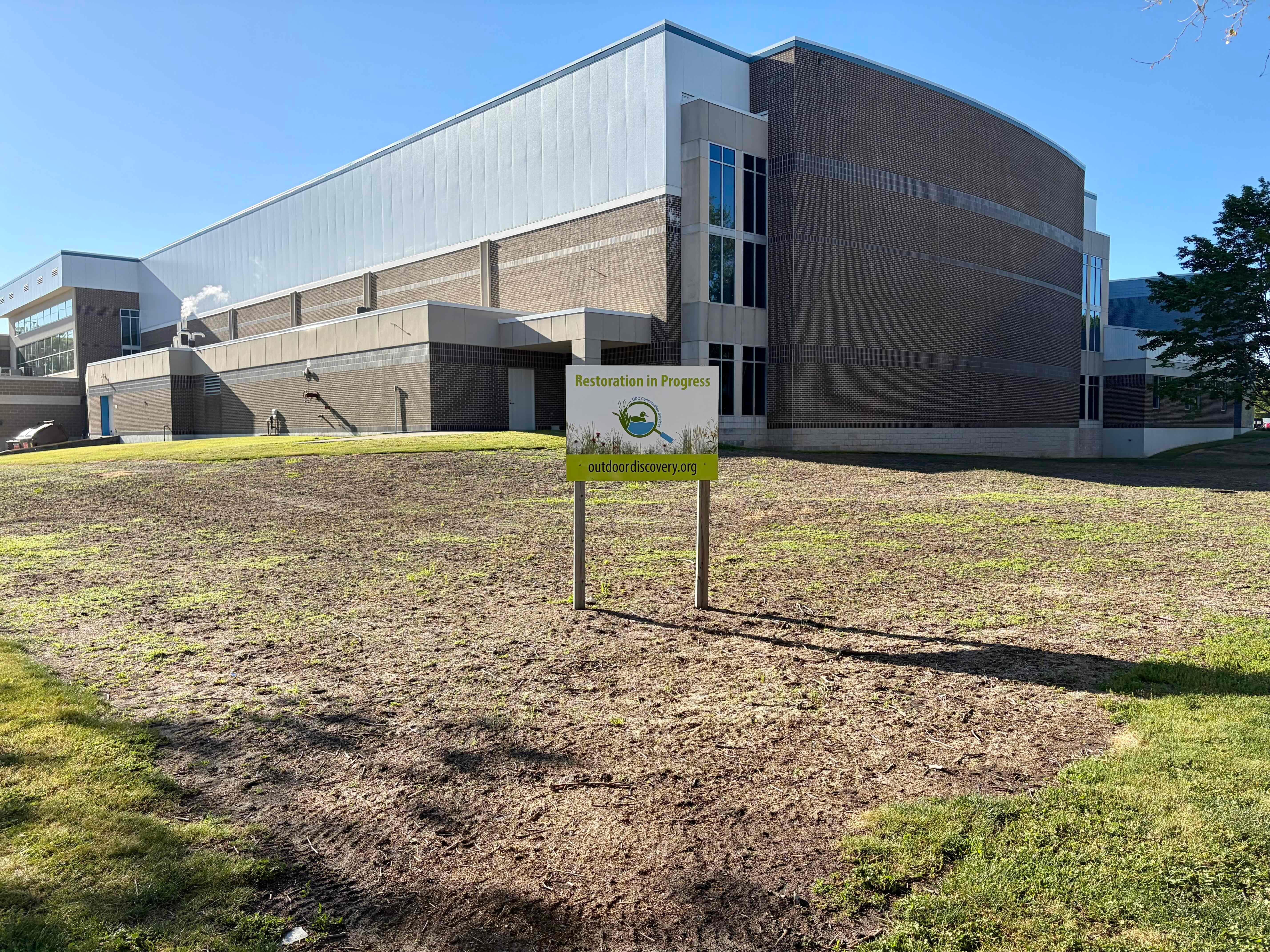
The Outdoor Discovery Center (ODC) has been serving West Michigan since the year 2000. According to Tanner Bricker, Conservation Services Director, the mission of the ODC is to advance outdoor education and conservation “through nature-based education, protecting natural ecosystems, and expanding outdoor access, [they] believe [they] can help create healthier, more resilient communities.”
Tanner shared that in his world, “it really comes down to restoring and creating these natural areas that are usually monocultures” and replacing them with spaces where native plants thrive and communities can gather, enjoy being outdoors, and hopefully learn about conservation.
“The main goals of the Aquatic Center project were to reduce maintenance of the existing lawn, create habitat for wildlife and pollinators, and provide biodiverse green space for community enjoyment and outdoor education. At its core, the project aims to transform underutilized lawn into a functioning ecosystem that supports pollinators, improves environmental health, reduces long-term maintenance needs, and demonstrates how communities can thoughtfully invest in more sustainable landscapes,” Tanner said.
He explained that “site preparation began in late summer of last year with removal of the existing turfgrass, continued this spring, and was seeded with a native seed mix in late May.”
The ODC seeded the area with “low-profile native grasses and a diverse array of wildflowers designed to provide blooms throughout the growing season.” Tanner expressed the importance of focusing on good root development within the first year of a project. So, while Holland residents may see some early blooms at the Aquatic Center such as black-eyed Susan, partridge pea, and sand coreopsis, most of the native perennials they’ve seeded won’t bloom until year two or three.
The Outdoor Discovery Center and the Holland Board of Public Works (BPW) have had a long-standing working relationship that has been hugely beneficial to both organizations. The relationship that ODC has with BPW is one of the things Tanner says he’s most proud of within his career. BPW doesn’t just encourage residents of Ottawa County to take up conservative efforts, they also model the initiative on their own land. “Holland BPW has been a strong example partner in this space, and many of the projects we are doing with them demonstrate what this looks like at scale within public infrastructure and managed lands,” Tanner explained.
In many ways these large-scale projects, such as at the Holland Aquatic Center and BPW facilities, have influenced and inspired homeowners to begin small-scale restoration projects on their own land. Tanner shared that they’ve seen conservation “efforts emerging across the city through local businesses, public spaces, and private landowners.”
According to Tanner, he often sees acres of turfgrass all over West Michigan that are underused and require a significant financial investment to maintain. These lawns, he said, also don’t offer much from an ecological standpoint. Thus, by creating a space that potentially better serves pollinators, wildlife, and the community, conservationists will also save a buck.
“It’s obviously not our main goal with these projects. But when done properly, they’re quite beautiful, in my opinion,” Tanner said when speaking of the aesthetic transformation of a conservation project, another potential benefit.
For residents of Ottawa County who are looking to make sustainability-minded lifestyle changes but aren’t ready to transform a lawn or don’t have a lawn, Tanner encourages open conversation. By talking about wildlife conservation, residents of West Michigan can be a part of the ODC’s education initiative and help normalize lawns that feature native plants rather than turfgrass.
For those who are curious about starting their own projects, the ODC offers free consultations. More information can be found on the website. Tanner also advises checking out local resources such as the Ottawa Conservation District and doing some initial research to learn more about what the best fit might be for your space and conditions.
“What excites me most about these types of projects is how they are helping grow interest in native plants, and how more people are asking how they can play a positive role in their local environment,” Tanner said. He explained, “Whether it's reducing unused lawn, installing native plants, or simply talking about it with others, native plantings give people an opportunity to participate in the ecology of their own community rather than simply observing it from a distance. I think projects like [the Holland Aquatic Center] are a helpful reminder that we're part of the ecosystem, not separate from it. Every decision we make about the landscape influences water, soil, wildlife, and ultimately our community.”
So, while we may be a year or two out from seeing the Holland Aquatic Center in full bloom with native plants, rest assured, the dead grass will soon be a thing of the past as wildflowers and prairie grasses take root. These native plants will bring with them new life and new purpose, a heralding of spring and new beginnings.

Jade Havenaar is a Holland native and a life-long lover of the lake, coffee, and a good book. She’s a former middle school teacher and a published author. After marrying the boy she met in a bar and traveling the US together, she and her husband welcomed their first born and Jade happily added “boy mom” to the list of hats she wears. When she’s not writing or changing diapers, she’s probably out adventuring with her Golden Retriever, Henry.
Copyright © 2025 Hollander Media. All Rights Reserved. This material may not be published, broadcast, rewritten, or redistributed without written authorization. By providing your email or phone number, you are consenting to receive emails, calls, and SMS/MMS messages from The Hollander and affiliates. Msg & data rates may apply.


.jpg)