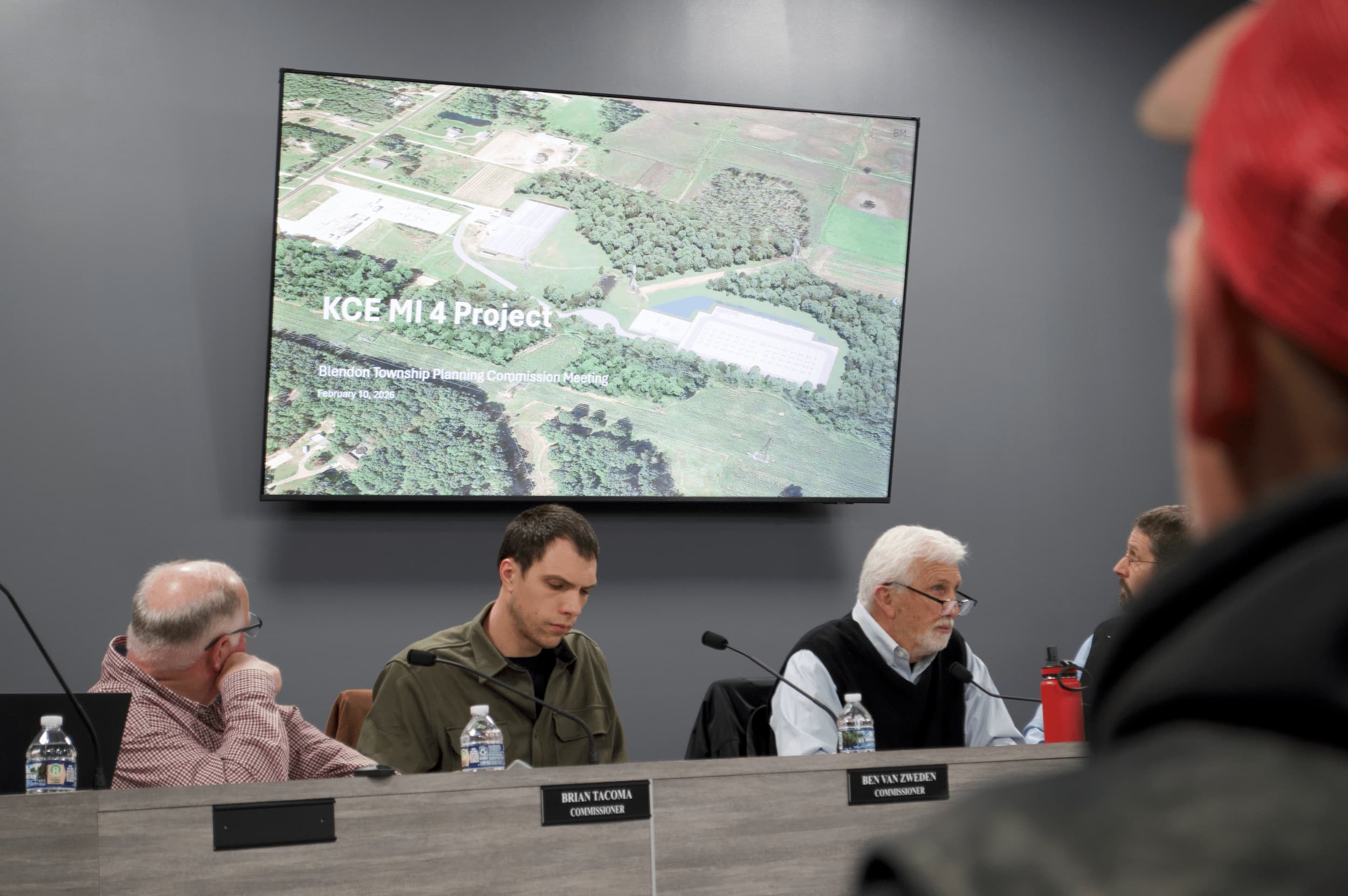
Precedents. It was a word that was tossed about throughout the Planning Commission's three-hour Special Meeting on Tuesday evening, February 10.
Two commissioners stood on precedents, one pointing to not having the authority to exempt dimensional variances and the other by asking the developer to obtain right-of-way as a driveway option.
Following the passing of the exemptions, the word also was used by a local resident who cautioned that with each step in this process, the commissioners were setting the precedents for future projects.
The obstacle to the precedents? Public Act 233, a Michigan law signed by Governor Whitmer which allows developers to bypass (uncooperative) townships and directly petition the state for construction of utility-scale projects.
At the previous Planning Commission meeting, the motion(s) had been tabled as to whether to approve Key Capture Energy’s (KCE) requested ordinance exemptions for a battery energy storage system (BESS). The vote was again before the commissioners. Prior to their discussion, KCE was given the floor to provide a brief recap of the project proposal, hitting on some of the ongoing concerns expressed by residents.
Brian Madigan, KCE’s Lead Project Developer, reiterated that the BESS, designed to help improve critical liability, would bring the township benefits such as $6 million in tax revenue over the life of the project and eligibility for a $500,000 grant with EGLE, providing construction jobs at the start. The BESS would encompass approximately 12 acres of a 40-acre parcel.
Acknowledging residents’ concern about a potential for decreased property values, Madigan shared that KCE had obtained an independent and peer-reviewed study of how the project might result in an adverse effect to neighboring property owners' home values. The analysis concluded that there is no demonstrated trend of negative impact on adjacent property values after a battery in the historic project.
Residents responded with laughter.
Next up, Wayne Sakura, a consultant with ERM, spoke on ground water. He said that the closest private well to the site is about 800 feet away, a far greater distance than the requirement of roughly 75 feet. As for the project itself, the minimum criteria is to be at least two feet above the groundwater level. The Blendon site would have a minimum of three feet—more in some areas. Additionally, the site findings showed that there's very little interaction of the surface water interaction with the groundwater, most importantly the aquifer, at a lower level.
The ball then was lobbed to the court of the Planning Commission.
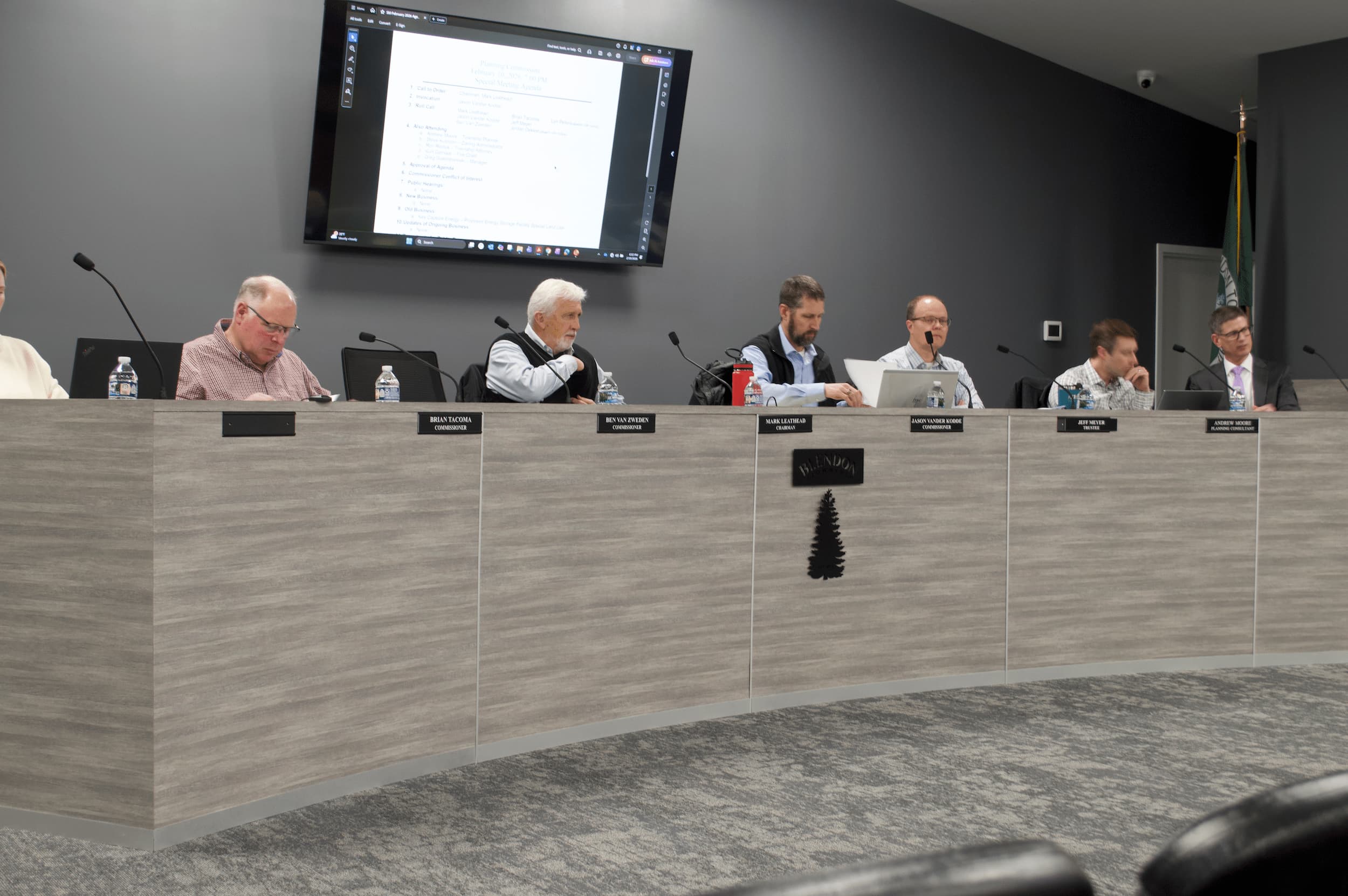
As way of background, Andrew Moore, Township Planner, explained that the zoning ordinance language on the BESS allows the Planning Commission to exempt the project from compliance to certain elements of the zoning ordinance. Initially eight potential areas were identified in which the application was unable to comply with the zoning ordinance. The eight had been whittled down to three.
Commissioner Ben Van Zweden again questioned whether the Planning Commission has the authority to make exemptions on dimensional requirements when that has been the role of the ZBA. Township Attorney Ron Redick assured the commissioners that these types of special land use provisions are common, and that granting the exemptions is a lawful mechanism for the Planning Commission to exercise this authority.
Van Zweden then asked Moore about the option of a private road in lieu of granting an exemption for the shared driveway. Moore didn’t think that option would be possible. Van Zweden disagreed, saying it might be undesirable, but not impossible.
Commissioner Jason Vander Kodde agreed with Van Zweden, suggesting KCE either submit a separate application for a private road or request permission from neighboring Consumers Energy and Wolverine to use their right-of-way.
Either option would remove the need for the driveway exemption.
Vander Kodde continued that in the past it has been the Planning Commission’s policy to require the applicant to request cross-access use from neighboring property owners.
The KCE team balked, first saying requesting land rights from either of those companies would not be an option. When Vander Kodde pressed, they changed their response to "not an option we would consider."
KCE questioned whether this was a reasonable request from a legal perspective, with one team member insisting: “We're not applying for private roads. We've submitted a compliant plan... The private road option is not a viable option for us... we believe the exemptions as presented by Andy can recommend for approval.”
Vander Kodde stood his ground, informing the Chair he was not in favor of granting a shared driveway extension when there were other options on the table that we could be pursued.
When asked if he wanted to vote on each exemption separately, Vander Kodde replied, “I don't want to do any of them without working through site plan questions and comments.”
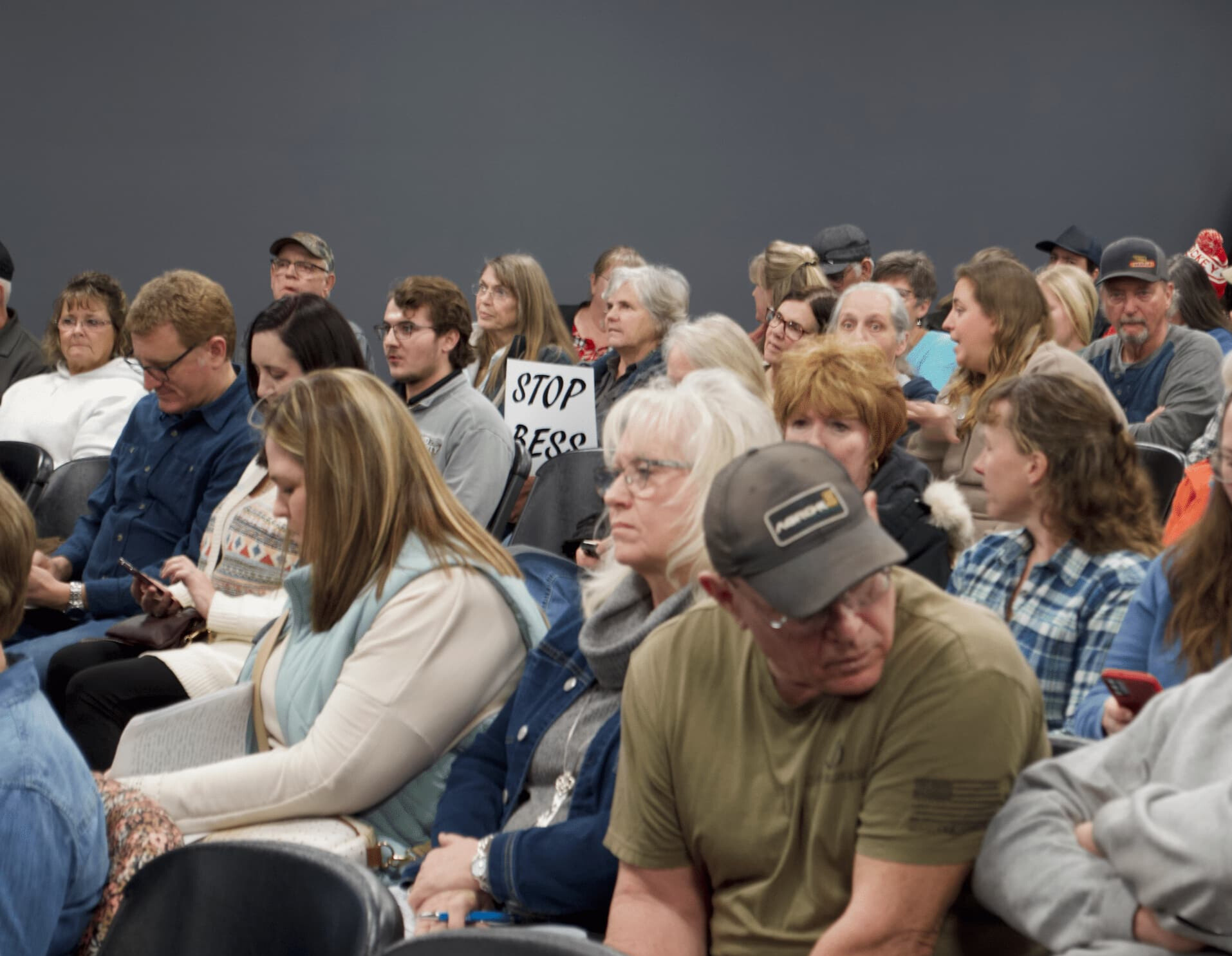
The room erupted in applause.
Exemption to #4: requirement of a paved area to allow vehicles to pass.
Voted on by roll call:
Ayes: Commissioners Mark Leathead, Brian Tacoma and Jeff Meyer.
Nos: Commissioners Ben Van Zweden and Jason Vander Kodde.
Absent with notice: Commissioners Jordan Dekker and Lyn Peters.
The crowd was audibly disappointed.
Chair Leathead addressed the crowd, explaining that none of the votes at this meeting would mean approval of the project. The Planning Commission will be looking at conditions next, such as water resources, potential water contamination, and fire. They also will be looking at the decommissioning conditions. He added that this is going to be a process and will take some time.
Exemption to #5: requirement of a minimum lot size of 40 acres.
Voted on by roll call:
Ayes: Commissioners Mark Leathead, Brian Tacoma and Jeff Meyer.
Nos: Commissioners Ben Van Zweden and Jason Vander Kodde.
Absent with notice: Commissioners Jordan Dekker and Lyn Peters.
Exemption to #6: requirement of shared driveways not exceeding 880 feet.
Voted on by roll call:
Ayes: Commissioners Mark Leathead, Brian Tacoma and Jeff Meyer.
Nos: Commissioners Ben Van Zweden and Jason Vander Kodde.
Absent with notice: Commissioners Jordan Dekker and Lyn Peters.
All three ordinance exemptions were passed.
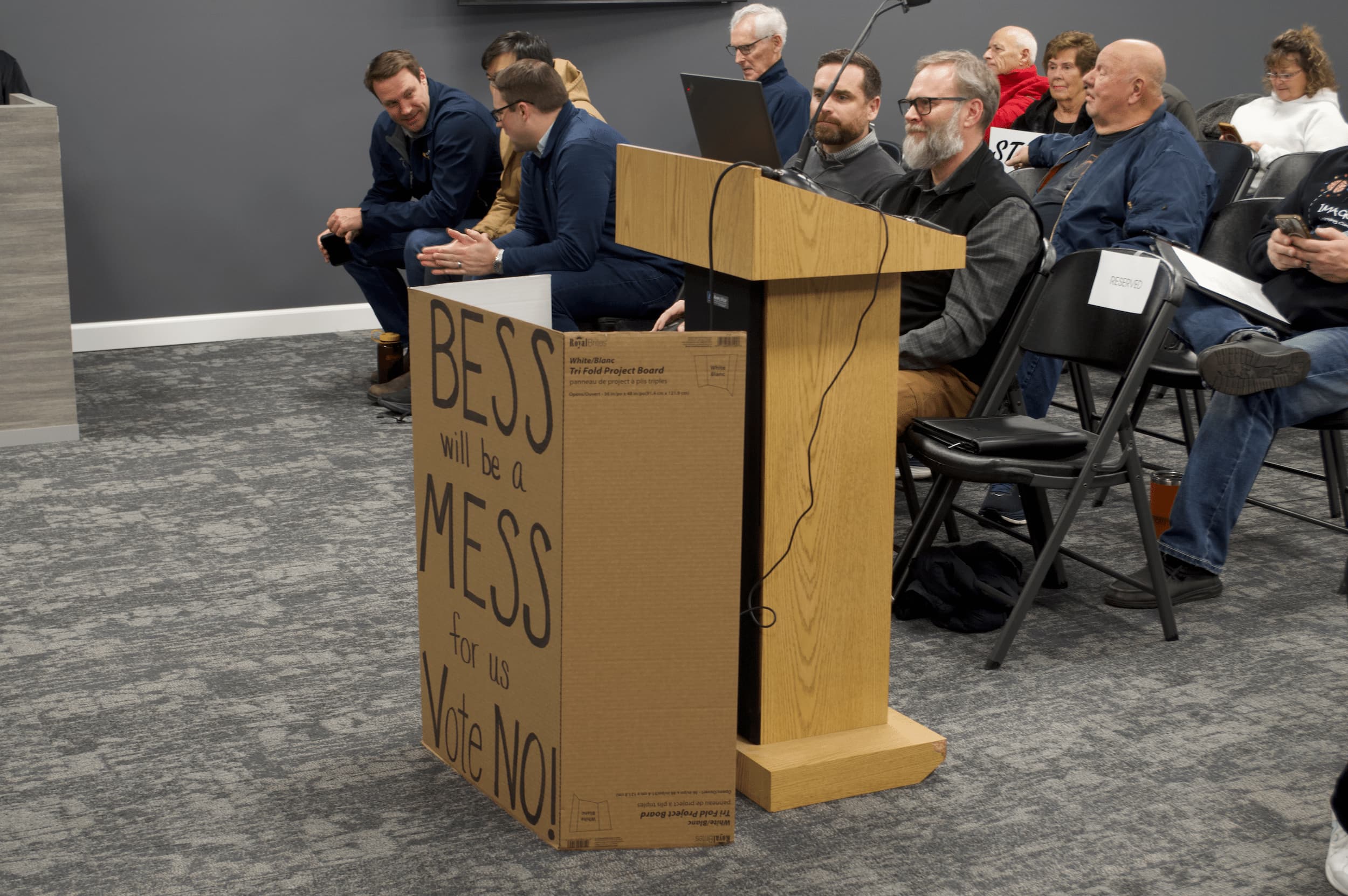
First to stand at the podium was local resident Bev Horinga. She reminded the Planning Commission that decisions set precedents. “When a township grants a variance, bends an ordinance or allows an exception outside the intent of its master plan, it is not just approving one project. It is quietly answering a future question before it is ever asked,” she said.
“Those documents are not suggestions," Horinga said. "They are promises made to us residents about how land is used, how neighborhoods will be protected, and how growth will be managed. When exceptions become routine, the plan loses its authority, the zoning becomes negotiable rather than important.”
A resident named Emily said that if PA 233 gets overturned, any projects approved by the state could be reversed—which would not be the case for those approved locally. She then encouraged the commissioners to get a second opinion on their legal counsel.
A young man introduced himself as Michael King, a GVSU graduate, but then refused to give his address other than Ottawa County. Several meeting attendees protested. Interestingly it was a KCE representative who came to King's defense, saying he wouldn’t be comfortable giving his address either. A few in the crowd argued that it’s part of giving public comment.
Rather than enforce the rule, the Chair allowed King to continue without providing an address. King shared that he’s passionate about clean energy and the investments going into the township.
Another GVSU student also only supplied an address of Ottawa County. He said he thought the project would open the doors for minorities and minority work and would bring hundreds of thousands of dollars into the economy.
Yet another GVSU student talked about how this “amazing project” would help lead sustainability. Addressing the Chair he said, “If you're going to make a decision that is an impact to my future and the rest of the students… I ask that you do it in our interest… It going to affect them [pointing at his fellow GVSU students] way more than it's going to affect a lot of the people in this room… This is for our future.
The seeming audacity of nonresidents supporting a project—from which they will bear no impact or consequence—was met with outbursts from the crowd, including questions of whether they were being paid to speak.
The remaining commenters were from Blendon Township:
One resident referred to the project as the “BESS monster,” saying it’s the most dangerous thing they could put in their backyards and in the township and with zero benefits to the community. She called it a “dirty energy,” toxic to the water and toxic to the air.
Another asked the commissioners why they even have a master plan if they’re just going to allow “financial bribes” determine their decisions. “Don't let KCE continue to bully you with PA 233 theater,” she said.
Local resident Sally Cronkright said what is happening is the fault of We the People. “We haven't been coming to meetings. We voted for you because you have an R by your name, and we just trusted that you were going to speak for us.” She added that when We the People are asleep, those in government make these laws. “We have responsibilities, we need to know our Constitution, we need to know the law and read our Bibles. We need to come to meetings, we need to get involved,” she said.
One resident questioned the commissioners about requiring KCE to get a denial letter from Consumers Energy regarding the driveway, suggesting it be the commissioners who write the letter. He likened it to people being told their assets will be seized. What do they do? Get rid of their assets. He added that similarly KCE is getting assessments on property values. 100% of the time studies are done in favor of the person writing the check.
Local resident Sarah said it seemed like residents’ pleas were falling on deaf ears and that the $500,000 the community will receive is "a drop in the bucket" to the collective cost residents and the township would need to recover from catastrophic failures. “Will you violate our trust?" she asked the commissioners. "Or will you truly put your trust in God and allow Him to guide you as you asked in the opening prayer?”
With the approval of the ordinance exemptions, new precedents were established and the proposal moved to the next step in the process.
The next Special Meeting will be March 4, at 7:00pm.

Krista Yetzke is a native of Ottawa County. A jeep-driving, guitar-playing wife, mom, and everyday adventurer, Krista was raised on the love of Jesus, the great outdoors, the arts, the value of frugality, and the beauty of food as medicine.
Copyright © 2025 Hollander Media. All Rights Reserved. This material may not be published, broadcast, rewritten, or redistributed without written authorization. By providing your email or phone number, you are consenting to receive emails, calls, and SMS/MMS messages from The Hollander and affiliates. Msg & data rates may apply.