HOLLAND — In a week shaped by national media narrative over immigration enforcement, two very different spaces in Holland became focal points for moral response and public action: the chapel at Hope College and the storefronts lining downtown streets.
Both were motivated by the same national narrative.
Among the individuals repeatedly named in protest statements and public messaging were Alex Pretti and Renée Good, who both lost their lives during separate federal enforcement encounters in Minneapolis.
According to publicly released video and law enforcement reporting, Pretti had engaged in confrontational behavior toward federal agents in the days leading up to his death. This included spitting on officers and violently damaging a federal SUV, smashing taillights during an earlier encounter. Federal authorities described his behavior as aggressive and escalating. Investigations into the fatal shooting itself remain ongoing.

In a separate incident, Renée Good was shot after driving a vehicle toward a federal agent, according to federal statements. Authorities reported that the agent fired after the vehicle struck or attempted to strike law enforcement personnel. While the incident has prompted investigation and protest, the reported conduct involved more than passive presence or verbal dissent.
These actions of spitting on officers, destroying government property, and using a vehicle in a confrontation, fall outside what most residents would recognize as ordinary civic engagement or peaceful protest.
Yet national political narratives surrounding these deaths have filtered quickly into local institutions.
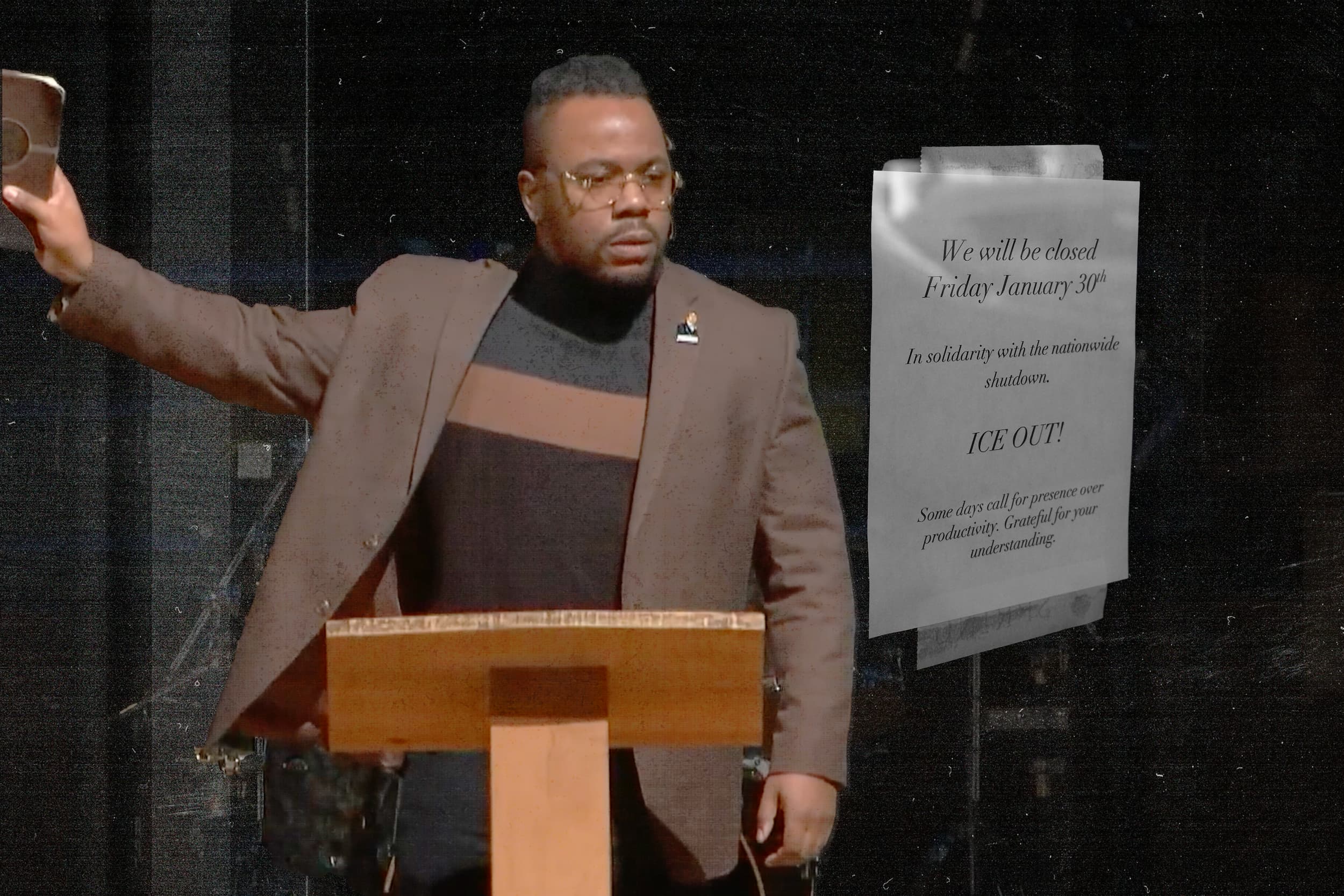
At a Monday morning chapel service, Hope College Chaplain Shomari Tate addressed students and faculty with a message centered on grief, power, and human dignity.
“The truth is this morning, the world is groaning,” Tate said. “Some of us came into this chapel carrying a grief that we cannot name, a fear that we have no language for, and an exhaustion that we cannot explain.”
Tate referenced recent deaths connected to immigration enforcement in Minnesota, describing shaken communities, grieving families, and rising protests. He framed the moment as one requiring moral clarity rather than silence.
Quoting Martin Luther, Tate told students that faith disconnected from present reality is no faith at all.
“If you preach the gospel at all times except for the times that you are currently living in, then you are not preaching the gospel at all,” he said.
Grounding his message in Proverbs 8, Tate argued that wisdom predates modern systems of power—including borders, policies, and enforcement agencies.
“Human dignity is older than human government,” Tate said. “The image of God is older than the paperwork of empire.”
He warned against equating order with righteousness.
“Any system that requires someone’s dehumanization to function is functioning in rebellion against God’s plan,” Tate said. “That is not wisdom. That is fear pretending to be order.”
While acknowledging the role of boundaries, Tate emphasized that they are meant to preserve life, not justify cruelty.
“God is not impressed by power that cannot practice mercy,” he said. “God is not honored by law and order that crushes the poor.”
The message concluded with a challenge directed at students preparing to leave campus.
“Will you be wise, or will you just be impressive?” Tate asked. “Wisdom is calling us out of comfort and into courage, out of silence and into solidarity.”
.jpg)
On Friday, several local businesses closed or shortened hours in recognition of a nationwide protest commonly referred to as “ICE Out,” which called for an economic shutdown in opposition to federal immigration enforcement. Participants were encouraged to refrain from work, school, and shopping for the day.
Some businesses opted for full closure. Others remained open while expressing solidarity through donations or public statements.
Businesses that closed or shortened hours included:
Businesses that remained open while expressing solidarity or donating proceeds included:
The Bluestocking Bookshop publicly stated it chose to remain open, noting recent weather-related closures and emphasizing that support could be shown without shutting its doors.
Despite the protest, most downtown businesses operated on normal winter hours. Sidewalks saw steady foot traffic for a January weekday. Many owners noted that winter is already a slow season and that even a single day of closure carries real financial consequences.
As the week unfolded, a clear distinction emerged.
Chapel messages aimed to shape conscience and long-term moral imagination. Business closures, by contrast, produced immediate and localized economic effects—lost revenue, shortened shifts, and reduced foot traffic impacts borne entirely by small businesses and their employees.
Federal immigration policy remained unchanged. Enforcement continued. No institutions altered course.
In choosing to “ICE out” economic activity as a form of protest, the businesses most directly affected were their own. From the chapel pulpit to Main Street, the intention may have been solidarity, but the consequence was economic self-denial.
Closing a local storefront does not freeze federal policy. It simply ices business owners out of their own day’s work.
As Holland prepares for Holland on Ice, an event designed to bring people downtown, support small businesses, and celebrate community, the contrast is striking.
One version of civic engagement invites people in. The other shuts the doors.
The question facing Holland is not whether compassion matters. It is whether institutions meant to serve students, neighbors, and customers should reflexively align themselves with activist narratives that obscure key facts or whether wisdom requires holding both human dignity and personal responsibility in view at the same time.
From the chapel pulpit to Main Street, standing in solidarity is never neutral. Neither are the consequences of who, exactly, that solidarity is for.
Eric McKee is a lifetime resident of West Michigan. Married with two energetic boys, he spends his days balancing work with dad life. Also, a firm believer that Almond St. Claus Windmill Cookies are the ultimate snack (and maybe a little too good).
Copyright © 2025 Hollander Media. All Rights Reserved. This material may not be published, broadcast, rewritten, or redistributed without written authorization. By providing your email or phone number, you are consenting to receive emails, calls, and SMS/MMS messages from The Hollander and affiliates. Msg & data rates may apply.