Let’s go back to more than a 100 years ago.
If you take a look back to the year 1919, you’ll find that this was a profound time for the United States. The nation was facing a series of changes—from the end of World War I, to the rise in fear of communism, to federal approval of the 19th amendment, to the growth of industries. It was the last year before we entered the famous Roaring 20s, a time of glitz, glamour, flappers, and the mischievous consumption of alcohol. It was also the time of more depressive events, such as the Great Depression.
To put the year into perspective, 1919 began a little less than three months after the end of the First World War. The Great Molasses Flood occurred in January, when a 2.3-million-gallon tank in Boston burst, sending a 35-mph wave of molasses content through the streets. A day later, the 18th Amendment, which instated prohibition, was ratified. The modern automatic pop-up toaster was invented by Charles Strite in May. And L. Frank Baum, who summered in Holland to find inspiration for his novel, The Wizard of Oz, died May 6, 1919.
So, what did Holland, Michigan look like in 1919? The city was known to be a quaint, rather secluded spot near the lakeshore. Its rich natural setting was a place for commerce, as dock areas allowed for the come-and-go of ships. It was also a place of retreat—the Waukazoo Inn and Ottawa Beach Hotel (neither of which exist anymore) offered stays for visitors. And fun fact: at this point in time, there was no such thing as Tulip Time, for that didn’t start until another ten years later.
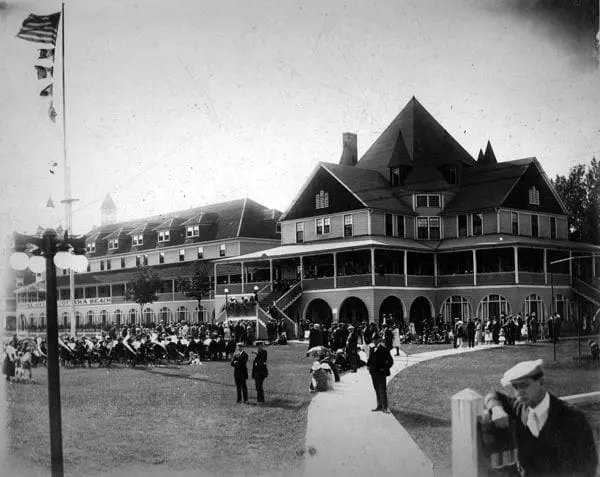
Holland hadn’t experienced much tourism at this point, as transportation access into the town was limited by train or early automobiles, still considered a luxury at the time. As time moved on, wealthier families found themselves either building or renting summer cottages along the lakeshore. This was likely one of the first indications of people visiting the area in a seasonal pattern.
The city, at this time, was facing a multitude of things: getting back on track after the end of the war, realizing a need for other commerce when alcohol was banned (this affected local breweries), and finding help for the growth of local industries that moved into the area.
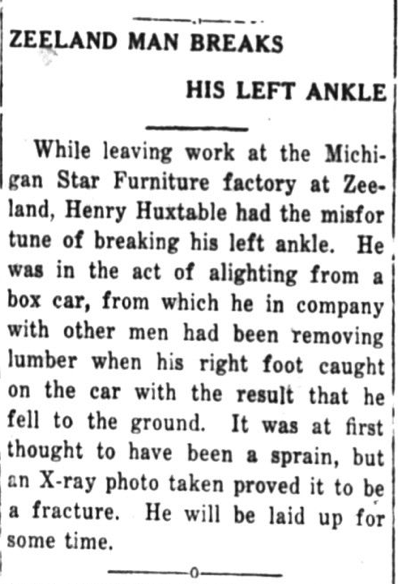
The main newspaper during this era was the Holland City News. It catered to the wider, English-speaking population. The remainder of the public primarily spoke Dutch. To put it into perspective, the city was rather humble. The news consisted of many advertisements, marriage and death announcements, college events, and perhaps some of the most unusual headlines.
If you sift through the archives from the Holland City News published in 1919, you’ll find some interesting snippets of headlines such as: “Zeeland Man Breaks His Left Ankle,” “Another Ottawa Co. Resident Has Forgotten What Banks Are For,” and “LOST: Turquoise Blue Sweater with White Angora Collar. Between Boston Restaurant and Model Drug Store. Return to Mrs. Edward Kruisenga, 120 E. 8th St. Reward.”
The newspaper featured advertisements for a multitude of things such as the New Edison, a phonograph designed by Thomas Edison; the grand opening of the self-serve grocery at Du Mez Bros; the numerous events featured at the Holland Fair (this was a big deal); and a notice that everyone’s favorite sugar waffles were only 52 cents at the local diner. Oh, and if you were in need of work, the Holland Furnace Company and Heinz Pickle Factory were frequent hirers.
As most of us already know, the Dutch settled into the area near Lake Macatawa, back then known as Black Lake. These travelers were led by Dr. Albertus Van Raalte, who sought religious and economic freedom. The City of Holland was founded in February 1847.
With Holland’s firm Dutch roots, cultural identity became more than just a historical origin—it evolved into a defining feature of the city’s landscape, architecture, and local pride. It was noticeable in the design of homes and other buildings, the names of streets and businesses, and of course, in the way people talked. It was within this context that uniquely inspired Dutch structures began to appear, turning even ordinary spaces into something more special.
So now that you’ve been put into context of the year 1919, perhaps we should turn the focus to something a bit more, let’s say, unexpectedly charming. Apart from all in which the nation and the City of Holland were experiencing in this particular year, something else, a bit more heartfelt, a tad whimsical, and assuredly unique in character, was being built: a windmill gas station.
A what, you may ask? Yes, a windmill gas station did exist here in Holland. It was located along 32nd Street across from what once was Harrington School, which has since been demolished. It had about three or four gas pumps and a general store.
Though it was not the famous De Zwaan windmill that sits on the grounds of Windmill Island Gardens, it was still a spectacle. And even more so, it was unexpected. It’s not that the windmill was entirely unexpected, just the fact that it was the chosen architecture for a gas station… a common building that we expect to appear boring.
Who would think up an idea such as a windmill gas station? The answer to that question is William C. Vandenberg, founder of the Vandenburg Oil Company. Born in 1884, he spent most of his life in Holland, Michigan. He first began his oil business in 1919 and oversaw its function up until its closure in 1946.
The Windmill Gas Station served as one of Vandenberg’s local projects. He built the gas station, a nod to his business in the oil industry as well as a homage to the predominant Dutch roots that characterized the area.
Unfortunately, the gas station was demolished sometime in the early 2000s. A new building has since taken its spot—with a mural of the former gas station painted on the side, facing the road for all to see. For newer residents, it’s likely they never knew a windmill gas station once stood there, while longtime locals can still vividly remember it.

The Windmill Gas Station was likely a landmark, as it served as a place to fill up one’s tank, grab a snack from the general store, and carry on the Dutch tradition of the beloved windmill.

Sierra Ozolins is a West Michigan native, currently a student at Hope College. As an athlete, she is passionate about fitness—from running to weightlifting. With a interest for politics and lifestyle, she is intrigued how local culture, community, and everyday events shape the world around her—often with an iced coffee in hand and her dog by her side.
Copyright © 2025 Hollander Media. All Rights Reserved. This material may not be published, broadcast, rewritten, or redistributed without written authorization. By providing your email or phone number, you are consenting to receive emails, calls, and SMS/MMS messages from The Hollander and affiliates. Msg & data rates may apply.